

How to Calibrate Button Load Cells in Compression: A Guide for Button Load Cell Calibration
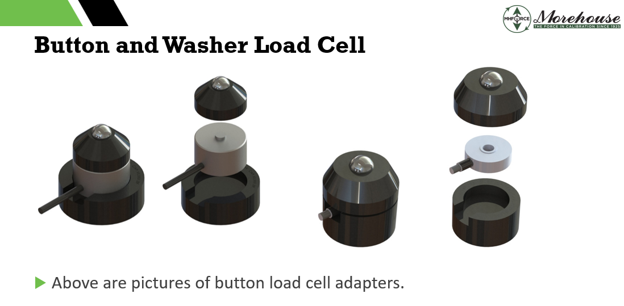
A button load cell looks like the easiest thing in the world to calibrate. It is small, it takes load through a domed top, and you set it under a press and push. What could go wrong 😊?
Almost everything, and quietly. Button and washer load cells are among the most sensitive instruments to how they are loaded, precisely because the load enters through a small, curved contact point. Move that contact point a hair off center, or let the cell rotate a few degrees, and the reading moves with it. The calibration of button load cells calibration lives or dies on alignment.
Here is the good news, up front: the fix is a pair of adapters, and the improvement is not subtle.
The number that should change your mind
We ran the same button load cell in the same Morehouse deadweight machine, once centered by hand and once with matched alignment adapters, and rotated the cell to check repeatability across orientations. Centered by hand, the rotational error came in at 1.045 %. With the button alignment adapters, it dropped to 0.199 %.
That is a 525 % improvement in rotational repeatability, on the same cell, on the same machine, changing nothing but the adapters. On an instrument rated to 0.1 %, a 1 % rotational error is the difference between a certificate that means something and one that describes whichever way the cell happened to sit that day.
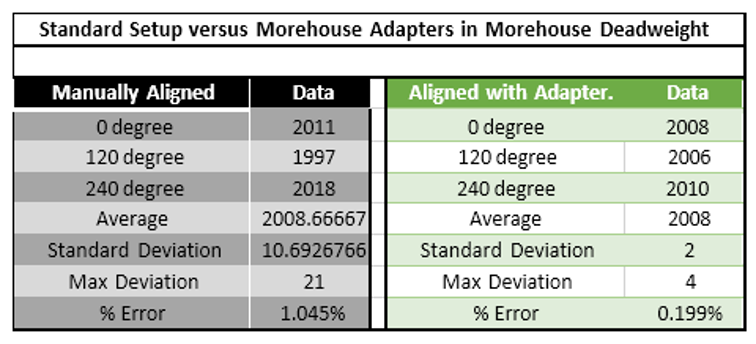
Standard hand-centered setup versus Morehouse alignment adapters in a Morehouse deadweight machine. Rotational error falls from 1.045 % to 0.199 %.
Why buttons are so alignment-sensitive
Picture the load path. A button cell takes force through a domed or spherical top into a small footprint. That geometry is wonderful for compactness and terrible for forgiveness. A larger cell loaded through a flat, integral top block has area to average across; a button has a point.
So, two things happen when a button is loaded carelessly. First, if the contact point sits off the cell's axis, part of the load becomes a bending moment the cell cannot separate from force. Second, if the cell can rotate between runs, each orientation presents a slightly different contact geometry, and the cell reads a slightly different value. Hand centering cannot control either one well enough for a 0.1 % instrument. A machined adapter can.
The adapters that do the work
For button and washer load cells, the tool is the Miniature Load Cell Adapter Set (CPD). A complete set is either a CD-1 button load-cell ball adapter or a CD-2 washer load-cell ball adapter, paired with a CP cell base adapter. The base adapter locates the cell; the ball adapter delivers load through a controlled, self-centering contact point instead of a hand-placed one. The set is compatible with common button and washer cells, including Cooper, Futek, Interface, Omega, and Transducer Techniques.
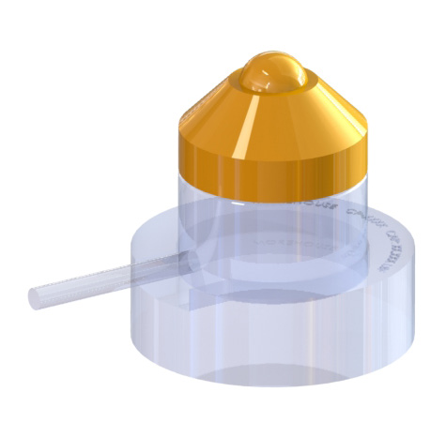
Miniature Load Cell Adapter Set (CPD): the CD-1 ball adapter delivers load through a repeatable contact point into the CP base.
The photographs below make the difference concrete. On the left, a button cell centered by hand; on the right, the same cell in the CPD adapters. The right-hand setup is the one that produced the 0.199 % result.
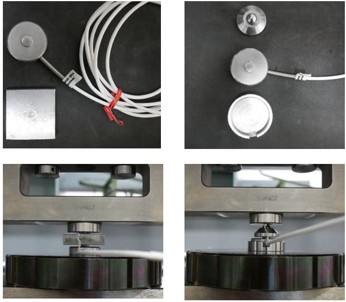
Hand-centered on the left, CPD alignment adapters on the right. The adapters improved performance by 525 %.
How to run the calibration
With the right adapters, the procedure is straightforward, and the discipline is in the details:
- Locate the cell in the base adapter. Seat the CP base so the cell sits concentric with the load line before any force is applied.
- Deliver load through the ball adapter. The CD-1 or CD-2 gives a single, repeatable contact point. Do not substitute a flat plate or a hand-placed ball; that is the setup you are trying to leave behind.
- Exercise the cell. Apply full-capacity load two or three times before recording, to settle the element and stabilize output.
- Check rotational repeatability. Because buttons are orientation-sensitive, take readings at multiple rotational positions, commonly 0, 120, and 240 degrees, and look at the spread. That spread is the very error the adapters were chosen to control, and it belongs in your uncertainty budget.
- Record against the reference at each point across the used range.
Put the alignment error where it belongs
A button cell's rotational spread is not noise to be ignored; it is a real, quantifiable contribution to measurement uncertainty. Capture it, include it in the budget, and report the expanded uncertainty with its coverage factor and coverage probability. If you issue a conformity statement, state the decision rule and whether uncertainty was considered. A pass mark on a button cell calibrated without alignment control is a pass mark with an asterisk, the end user never sees.
Button load cells are not hard to calibrate. They are hard to calibrate by hand in a homemade press or machine that isn’t plumb, level, square, and rigid. Then if you have the right machine, using adapters that deliver load through a repeatable point, exercise it, check it across rotation, and the same sensor that scattered over 1 % settles inside 0.2 %. If you calibrate button or washer cells and you are still centering by hand, 525 % or higher, is likely sitting on the table waiting for you. Talk to us about a CPD set matched to your cells, and put it in the budget instead of your reputation.
For more information on our adapters click here.
And this is just a small post to raise awareness of how important compression force calibration setups can be. Our force calibration book is over 400 pages and free to download.
About Morehouse
We believe in changing how people think about Force and Torque calibration in everything we do, including, "How to Calibrate Button Load Cells in Compression: A Guide for Button Load Cell Calibration"
This includes setting expectations and challenging the "just calibrate it" mentality by educating our customers on what matters and what may cause significant errors.
We focus on reducing these errors and making our products simple and user-friendly.
This means your instruments will pass calibration more often and produce more precise measurements, giving you the confidence to focus on your business.
Companies around the globe rely on Morehouse for accuracy and speed.
Our measurement uncertainties are 10-50 times lower than the competition, providing you with more accuracy and precision in force measurement.
We turn around your equipment in 7-10 business days so you can return to work quickly and save money.
When you choose Morehouse, you're not just paying for a calibration service or a load cell.
You're investing in peace of mind, knowing your equipment is calibrated accurately and on time.
Through Great People, Great Leaders, and Great Equipment, we empower organizations to make Better Measurements that enhance quality, reduce risk, and drive innovation.
With over a century of experience, we're committed to raising industry standards, fostering collaboration, helping with understanding risk, and delivering exceptional calibration solutions that build a safer, more accurate future.
Contact Morehouse at info@mhforce.com to learn more about our calibration services and load cell products.
Email us if you ever want to chat or have questions about a blog.
We love talking about this stuff. We have many more topics other than, "How to Calibrate Button Load Cells in Compression: A Guide for Button Load Cell Calibration"
Our YouTube channel has videos on various force and torque calibration topics here.