

Why Do Force Calibration Adapters Matter? The Measurable Cost of the Wrong Setup
A load cell that reads to 0.005 % of full scale in the laboratory can degrade to 0.5 % of full scale, or worse, in the field, mounted with adapters that introduce bending, side loading, or torsion. Same cell. Same certificate on the wall. A hundred times the error.
That sentence is the case for taking force calibration adapters seriously, and the numbers behind it are not marketing. They come out of our own lab, on real instruments, and they are large enough to change how a quality manager thinks about a purchase order.
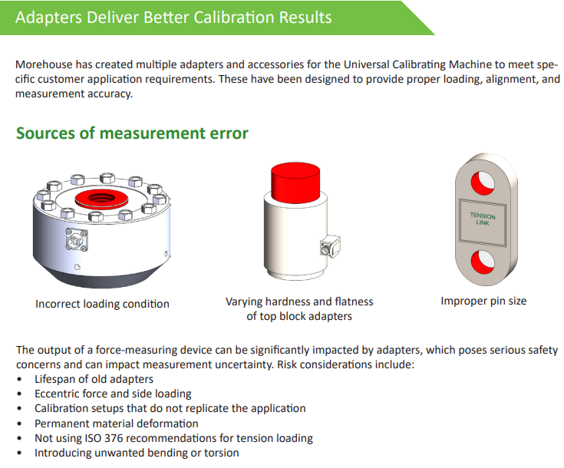
Three common sources of adapter-induced error are an incorrect loading condition, varying hardness and flatness of the top block, and an improper pin size.
What a wrong adapter costs
Start with the error itself. Loading a button load cell even slightly off-center introduces eccentric loading that can shift the output by as much as 10 % of the rated output. On a tension link, substituting pins that differ only slightly in diameter has shifted readings by as much as 1.7 %; on an instrument rated to 0.1 %, that is 17 times the allowable error. Changing only the hardness of the top block has shifted the indicated force by as much as 0.5 % of full scale, with nothing else changed.
These are not edge cases. They are ordinary substitutions, made in good faith, by people trying to get a calibration done. The adapter is the quiet variable that moves the reading before anyone sees an irregularity in the data.
Did the pin match the one used in the field? Was the top block the same hardness? Did anyone check before the certificate went out?
What does the right adapter recover?
Now the other direction. In our testing, proper alignment adapters improve results by a factor of 2 to 10. On a button load cell, moving from hand centering to Morehouse alignment adapters cuts the reproducibility error from 1.045 % to 0.199 %, better than a factor of five, on the same cell and the same machine. Using an integral top block that matches the field setup, such as the CG-1 family, improves the ASTM lower limit factor (LLF) by 42 % in our testing, from 0.553 lbf to 0.320 lbf, versus the same cell with no adapter installed, which extends the cell's usable range without changing the cell at all.
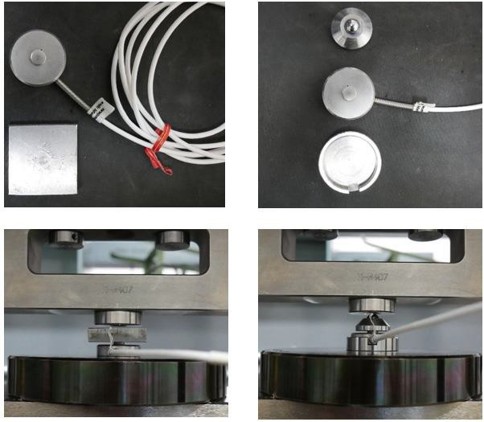
Hand-centered on the left, alignment adapters on the right. On this button load cell the adapters reduced the reproducibility error by more than a factor of five.
An adapter does not rescue a worn or damaged sensor. But on a sound instrument, the right adapter is the difference between meeting a tolerance and missing it.
Why is the effect so large?
Force is a single-axis measurement, and a load cell cannot tell real force from a bending moment that arrives off axis. Keep the line of force pure and free from eccentric loading, and the cell reports what it was built to report. Introduce misalignment, and the cell reports the misalignment too.
The size of the effect comes from leverage. Misalignment of less than 1/8 in (3.2 mm) produced an error of 0.752 % of full scale on a 10 000 lbf (44.5 kN) S-beam load cell, and raised the expanded uncertainty at the time of calibration from about 10 lbf (44 N) to about 90 lbf (400 N), a ninefold increase. A misalignment small enough that most technicians would never notice dwarfs the specification that the whole calibration was meant to verify. That is why, no matter how good an operator may be, they are no match for a precision-machined adapter.

A compression setup built to keep the load cell on axis: top block, alignment plug, and lower yoke compression block.
The cost does not stop at the certificate
Here is the part that turns a metrology detail into a business number. A calibration error does not stay on the certificate. It propagates into every measurement the cell makes for the next twelve months.
A 0.5 % adapter-induced shift based on switching the hardness of a top compression block on a load cell used 1 000 times per year is 1 000 measurements made against the wrong reference. In a lab making conformance decisions, that shift collapses the test uncertainty ratio (TUR), increases the probability of false accept (PFA), and eventually manifests as rework, scrapped product, or an audit finding. At a burdened labor rate of $100–200/hr, a small number of avoided rework events, or a single averted false accept on a critical application or measurement, can recover the cost of the right adapter many times over.
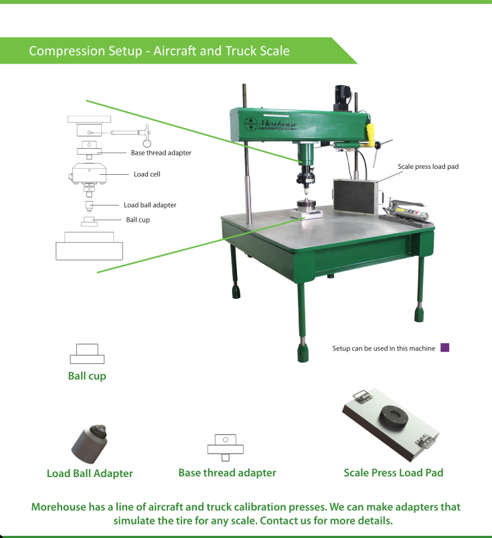
A Morehouse aircraft and truck scale calibration press. Purpose-built adapters simulate the tire for any scale, one of many applications where the right adapters keep the load line pure.
What this means for how you buy
Adapters are not the place to economize by reaching for whatever is on the shelf. The economical choice is the adapter matched to your application, because it pays for itself the first time it prevents a bad decision. In our experience, customers who invest in adapters matched to their application typically pay them off within the first year through reduced rework, tighter TURs, and fewer audit surprises.
Three habits capture most of the benefit:
- Match the field condition. Reproduce thread engagement, top-adapter hardness and flatness, and pin size so the certificate reflects how the instrument is used.
- Send the top block. When a load cell goes out for calibration, include its top block; an integral block like the CG-1 reduces errors and reproduces the field setup.
- Retire adapters on schedule. These are load-bearing parts with a service life. Any cracking, deformation, thread wear, plating loss, or unusual rotation on a load button is grounds for immediate replacement.
Force calibration adapters are the cheapest large lever in the whole measurement chain. They can move a reading by seventeen times an instrument's accuracy specification in the wrong direction, or recover a factor of 2 to 10 in the right one. Match the adapter to the application, keep the load line pure, and let the certificate mean what it says. Talk to us before you order, and we will match the adapter to your machine and your instrument so the number your lab depends on is the number you actually get.
Want to go deeper? Download the free Force Calibration eBook, sign up for the Metrology Mastery Series, our free weekly email training, or do both.
About Morehouse
We believe in changing how people think about Force and Torque calibration in everything we do, including, "Why Do Force Calibration Adapters Matter? The Measurable Cost of the Wrong Setup"
This includes setting expectations and challenging the "just calibrate it" mentality by educating our customers on what matters and what may cause significant errors.
We focus on reducing these errors and making our products simple and user-friendly.
This means your instruments will pass calibration more often and produce more precise measurements, giving you the confidence to focus on your business.
Companies around the globe rely on Morehouse for accuracy and speed.
Our measurement uncertainties are 10-50 times lower than the competition, providing you with more accuracy and precision in force measurement.
We turn around your equipment in 7-10 business days so you can return to work quickly and save money.
When you choose Morehouse, you're not just paying for a calibration service or a load cell.
You're investing in peace of mind, knowing your equipment is calibrated accurately and on time.
Through Great People, Great Leaders, and Great Equipment, we empower organizations to make Better Measurements that enhance quality, reduce risk, and drive innovation.
With over a century of experience, we're committed to raising industry standards, fostering collaboration, helping with understanding risk, and delivering exceptional calibration solutions that build a safer, more accurate future.
Contact Morehouse at info@mhforce.com to learn more about our calibration services and load cell products.
Email us if you ever want to chat or have questions about a blog.
We love talking about this stuff. We have many more topics other than, "Why Do Force Calibration Adapters Matter? The Measurable Cost of the Wrong Setup"
Our YouTube channel has videos on various force and torque calibration topics here.