

How to Calibrate a Cable Tensiometer: The Cable is Part of the Measurement
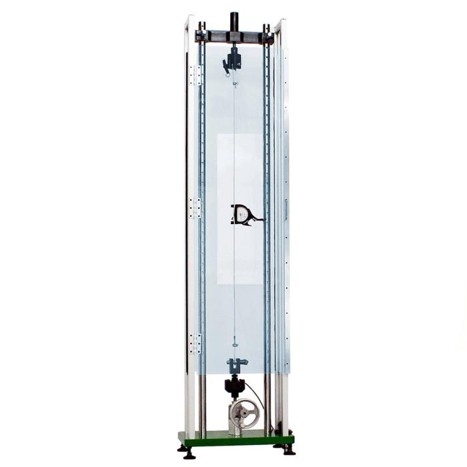
A cable tensiometer never touches a load cell or a hook. It clamps onto a cable and reads the tension in it. That one difference makes it among the trickier instruments to calibrate honestly, because the cable itself becomes part of the measurement.
Get cable tensiometer calibration wrong, and you will not just have a slightly off number. You will have a number that was correct for a cable you will never see again.
Why the cable moves the reading
A cable tensiometer does not measure tension directly. It clamps on, deflects the cable a fixed amount, and reads the force that deflection takes. That force depends on how stiff the cable is, and stiffness comes down to three things: length, cross-sectional area, and material. A cable behaves like a spring. The deflection of a uniform cross-section in tension is δ = FL/AE. Read the formula plainly: more area stiffens the cable, a stiffer material stiffens it, and more length softens it. A longer cable has a lower spring rate, so the tool adds less tension when it clamps on. Clamp the same tensiometer onto two different cables and you get two different numbers. Both can be correct.
What you are calibrating
A cable tensiometer is a device, analog or digital, that clamps onto a cable, wire, or rope and measures its tension. It is used to set and check tension in aircraft control cables, guy wires, and rigging. Three variables move its reading more than anything else:
- The length of the cable. A shorter cable is more rigid, so short cables read highest and show the largest differences, and the effect is largest at the low end of the range.
- The method used to clamp and read. More on the two methods below.
- The type of cable. GAC is galvanized aircraft cable and SSAC is stainless steel aircraft cable, and the two do not read identically.
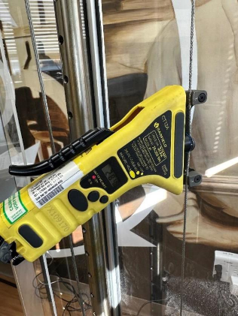
A digital cable tensiometer clamped onto a cable in a Morehouse PCM-2MD-T1 cable tensiometer calibrator.
The right equipment
The right machine applies a known tension to a real cable while a reference standard at the base carries the true force, so the strain of clamping does not corrupt it. The Morehouse Cable Tensiometer Machine (PCM-2MD-T1) generates tension up to 2 000 lbf (8.9 kN) on cables up to 5 feet long, with a 500 lbf reference load cell calibrated to ASTM E74 against deadweight primary standards known to better than 0.002 % of applied force. The expanded measurement uncertainty for the Morehouse cable tensiometer typically falls between 0.02 % and 0.04 % of the applied force.
Use a cable of at least 3 feet, lying flat, with no bends or kinks. Cables in the 18 in to 24 in range read differently, so match the length the manufacturer specifies. And do not calibrate a cable tensiometer on a torsion cell built for torque wrenches with a short cable: the force there is calculated rather than measured, and it carries error and uncertainty components that are large and very hard to quantify.
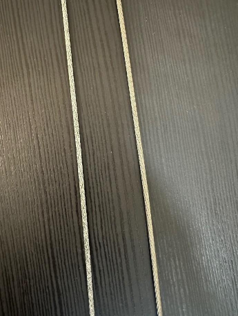
Two aircraft cables of the same nominal size: galvanized (GAC) and stainless (SSAC) do not read the same on the same tensiometer.
One fixed point or two
There are two kinds of calibrating machine, and the difference matters. A deadweight calibrator such as the Morehouse 774000 hangs weights, so clamping the cable adds no force. That is a machine with one fixed point. The PCM-2MD-T1 uses two fixed points, so when the tensiometer clamps it shortens the span between them and adds tension. Neither machine is wrong. They answer different questions, and the right one depends on how the tensiometer is used in the field.
Two methods, two different answers
On a two-fixed-point machine you can run either of two methods, and they do not agree:
- Clamp and adjust. Load close to the target, clamp the cable, then trim the force back to the nominal value. For example, load to 460 lbf, clamp, read 495 lbf, and adjust back to 500 lbf. Because you compensate by hand for the tension the tool added, the result is close to the one-fixed-point deadweight answer.
- Clamp only. Load to the target, clamp, and read. Here an applied 500 lbf might climb to 528 lbf when clamped. This method captures the internal tension the tool adds during a real measurement, so it better represents field use.
The difference between the two methods is largest at the low test points and stays close to a constant offset, because clamping shortens the effective cable length by a fixed, repeatable amount. So the method is not a detail. It is a decision you make to match the customer, and it belongs on the certificate.
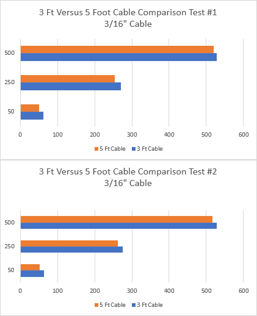
Comparing a 3 foot and a 5 foot length of the same 3/16 in cable: the percentage difference shrinks as the applied force rises.
Replicate the field, then state the result
Best practice is to match how the customer uses the instrument. Are they clamping onto an already-tensioned cable, or adjusting tension to a calibration chart? Pick the method that matches, and record the cable length, cable type, and method, because each one changes the number. In our testing the standard deviation across points is typically 1 lb or better, and repeatability across six repeated measurements runs from 0.41 lb to 1.03 lb.
Report the expanded uncertainty with its coverage factor and coverage probability, for example U = 0.02 % to 0.04 % of applied force, k = 2, approximately 95 % confidence. If you issue a conformity statement, state the decision rule and whether the tensiometer's tolerance is met once uncertainty is accounted for.
A cable tensiometer will give honest service if it is calibrated on a real cable, at the right length, with the method that matches the field. If you need a cable tensiometer machine and a set of standard cables sized for your work, talk to us before your next calibration is due.
About Morehouse
We believe in changing how people think about Force and Torque calibration in everything we do, including, "How to Calibrate a Cable Tensiometer: The Cable is Part of the Measurement"
This includes setting expectations and challenging the "just calibrate it" mentality by educating our customers on what matters and what may cause significant errors.
We focus on reducing these errors and making our products simple and user-friendly.
This means your instruments will pass calibration more often and produce more precise measurements, giving you the confidence to focus on your business.
Companies around the globe rely on Morehouse for accuracy and speed.
Our measurement uncertainties are 10-50 times lower than the competition, providing you with more accuracy and precision in force measurement.
We turn around your equipment in 7-10 business days so you can return to work quickly and save money.
When you choose Morehouse, you're not just paying for a calibration service or a load cell.
You're investing in peace of mind, knowing your equipment is calibrated accurately and on time.
Through Great People, Great Leaders, and Great Equipment, we empower organizations to make Better Measurements that enhance quality, reduce risk, and drive innovation.
With over a century of experience, we're committed to raising industry standards, fostering collaboration, helping with understanding risk, and delivering exceptional calibration solutions that build a safer, more accurate future.
Contact Morehouse at info@mhforce.com to learn more about our calibration services and load cell products.
Email us if you ever want to chat or have questions about a blog.
We love talking about this stuff. We have many more topics other than, "How to Calibrate a Cable Tensiometer: The Cable is Part of the Measurement"
Our YouTube channel has videos on various force and torque calibration topics here.