

Common Tension Force Calibration Setups: Let the Load Find its Own Axis
Pull a load cell in tension, and you introduce a problem compression may not have. The load string can twist. A thread can cock a few thousandths off center. A clevis pin can sit against one side of its hole instead of being centered. Every one of those small sins bends the load off the cell's axis, and the cell reports the error as if it were force.
A sound tension force calibration setup is the discipline of removing those sins before they reach the sensor. The goal is the same one that governs all good force work: keep the line of force pure. In tension, the tool that does most of the work is self-alignment.
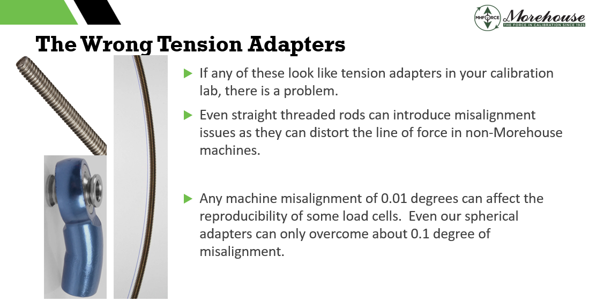
Note: These are examples of the wrong type of common tension force calibration setup.
Start with the tension member
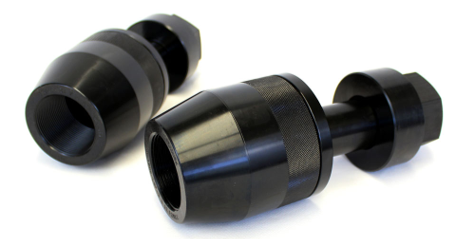
The heart of a Morehouse tension setup is the Tension Member Assembly (TMA). One member installs on the lower yoke platen, and the other on the lower fixed platen; the built-in self-alignment automatically brings the applied force onto the instrument's force line. You are not trusting the operator to center the string by hand. The hardware does it the same way every run.
A TMA is sized to the machine. A 10 000 lbf (44.5 kN) UCM uses a TMA-12; a 120 000 lbf (533.8 kN) machine uses a TMA-120. The part format, TMA-C-TR-TB, encodes the capacity in klbf, the rod length in inches, and the pass-through bushing diameter. Match the assembly to your machine capacity and your instrument's mounting, and the alignment problem is mostly solved before you apply load.
TMA kits are available for all capacity machines from the PCM, BCM to custom ones for a 1.15 million lbf (5 MN) UCM.
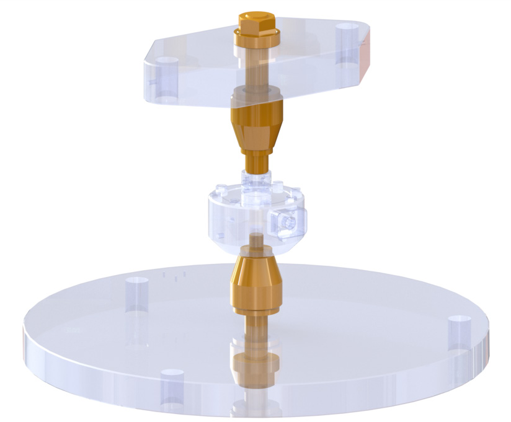
Tension Member Assembly (TMA) with coupling nut, retaining ring, tension rod, alignment bushing, and spherical nut.
The standard load cell setup, 1 000 to 120 000 lbf
For most load cells between 1 000 lbf and 120 000 lbf (4.4 kN to 534 kN), the tension setup runs tension member to threaded adapter to load cell to threaded adapter to tension member, mirrored top and bottom. The only question you have to answer is thread direction.
Here is the rule, and it is worth committing to memory. Think of it like Napoleon Dynamite's liger: a liger only comes from a male lion and a female tiger. Swap the pairing, a male tiger and a female lion, and you get a tigon instead, a different animal entirely. A TA-M male-threaded adapter screws into a female-threaded loading boss on the unit under test. A TA-F female-threaded adapter accepts a male-threaded loading rod. If your cell has internal threads, you need TA-M. If your cell has external threads on a loading rod, you need TA-F. Get this backward, and the parts simply will not mate, the same way swapping the male and female in the pairing gets you a tigon instead of a liger. Get the thread size wrong, and you either cannot seat the load cell, or you seat it on too few threads to carry the load safely.
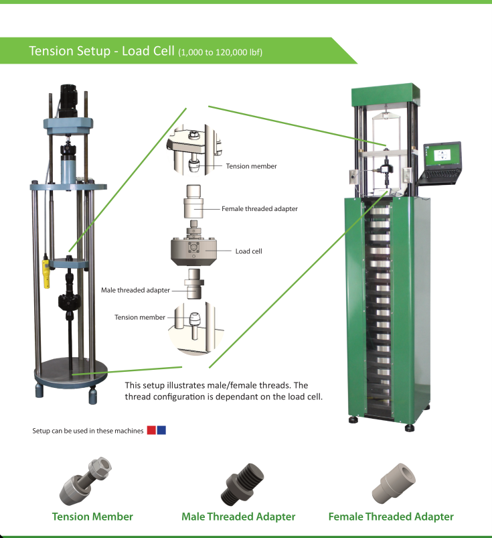
Tension setup, load cell 1 000 to 120 000 lbf (4.4 kN to 534 kN). Thread configuration depends on the load cell.
The high-capacity setup, 200 000 to 1 200 000 lbf
Above 200 000 lbf (890 kN) the members and threads grow, and the adapters are usually custom male and female threaded pieces matched to the cell. The principle does not change. The load still travels through a self-aligning member into a threaded interface sized to carry it. What changes is that at 1 200 000 lbf (5.34 MN) there is no room for a guess: the thread engagement, the rod diameter, and the alignment all have to be right, because the energy stored in the load string is enormous. For these capacities, contact Morehouse for the custom threaded adapters rather than adapting something on hand.
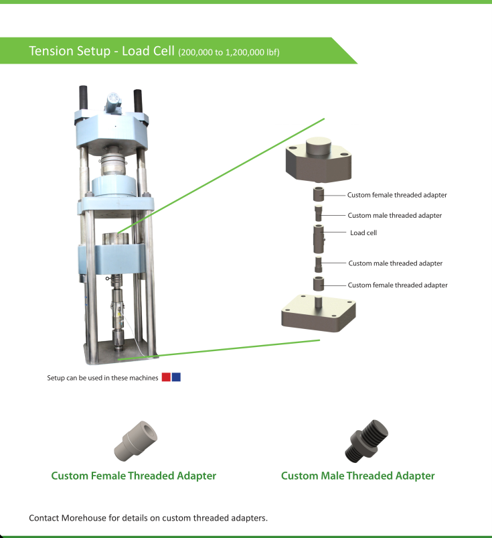
Tension setup, load cell 200 000 to 1 200 000 lbf (890 kN to 5.34 MN), custom threaded adapters.
Why self-alignment beats a careful operator
It is tempting to think a skilled technician can center a tension string well enough by eye. The data says otherwise. No matter how good an operator may be, they are no match for a precision-machined adapter that removes the degree of freedom entirely.
Think about what the operator is fighting. Thread clearance, hole clearance, and the natural tendency of a hanging load to seek its own hanging point all pull the string off axis in ways too small to see and large enough to measure. A self-aligning member does not center the load better than a person; it makes off-center loading unlikely, not impossible: a spherical radius with poor surface finish can still let it happen. That is why ISO 376 recommends tension setups that help reduce bending or torsion, and why the Morehouse TMA should be the default adapter.
Note: The TMA is not always the right adapter. Some setups call for a flexure, a more expensive option, or a softer contact material instead. Most of the time, though, following ISO 376 keeps the setup simple and the results accurate.
Surface finish matters as much as alignment
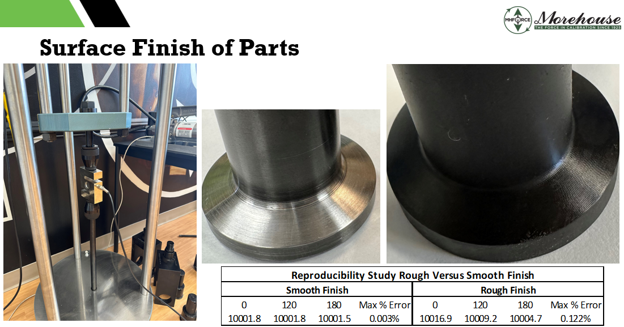
Alignment gets the attention, but the finish on the mating surfaces decides whether that alignment holds up under load. A tension member's spherical nut and socket only pivot freely if the bearing surfaces are machined smooth. Let that surface roughen or corrode, and the joint starts to bind. Once it binds, it stops acting like a pivot and starts acting like a rigid link, and the bending the TMA was built to remove comes right back.
Threaded interfaces carry the same risk. A rough or galled thread does not seat the same way twice. Two technicians torquing the same joint by feel can land on two different amounts of thread engagement, and that difference shows up as a small, hard-to-diagnose shift in the calibration result. Stainless-on-stainless threads gall easily; a light anti-seize and a clean, undamaged finish are cheap insurance on a fixture you assemble and disassemble every week.
The loading boss matters too. If the load cell's boss face and the adapter's mating face are not both flat and clean, the interface seats unevenly, and you have put the off-axis loading back in that the tension member was there to remove. Inspect mating surfaces before every setup, not just thread size and capacity. A part that fits is not the same as a part that seats square.
Habits that hold across every tension setup
- Follow ISO 376 for tension. Minimize bending and torsion, and use the self-aligning tension member to keep force on the instrument's axis.
- Match the thread to the boss. Confirm TA-M versus TA-F and the exact thread before the cell arrives, not at the machine.
- Seat under a light preload. Bring the string hand-tight, apply a small preload to settle every threaded joint, then begin the run.
- Reproduce the field mounting. If the cell is used with a particular adapter or rod end in service, calibrate it that way so the certificate matches the application.
- Inspect the mating surfaces. Check threads, bosses, and bearing surfaces for galling, corrosion, or rough finish before every setup; a degraded surface reintroduces the misalignment the tension member is there to remove.
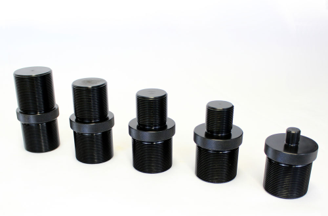
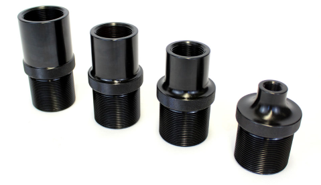
Skip the piecemeal build: the Quick Change Tension Adapter Value Kit.
Everything covered above (the TMA, the TA-M and TA-F adapters, the swiveling tension members) comes together in one kit. The Quick Change Tension Adapter Value Kit includes the tension members and tension adapters needed to run tension calibrations on a Morehouse Universal Calibrating Machine or any other machine built for force calibration. The swiveling tension members mount on the tension side of the machine, and the adapters install the unit under test between them.
Buy the pieces individually, and you pay full price for every one. Buy the kit, and the cost drops 20 % below buying the same items separately. Changeover time drops with it: one set of swiveling tension members and adapters covers a range of instruments, so you are not hunting for a different fixture every time the job changes. Four maximum capacities are available: 120 klbf, 60 klbf, 30 klbf, and 12 klbf.
The kit also earns its keep on accuracy, not just convenience. Each tension member uses a spherical-radius contact built to ISO 376, so alignment improves the same way it does everywhere else in this article: by removing the operator's hands from the equation, not by trusting them more. One tension member works across several adapters, which simplifies the setup itself. And the kit expands as your work does; add tension adapters, clevises, or rod ends later, or extend into crane scales, tension links, and dynamometers with additional clevis assemblies, without buying a second kit from zero.
The setups above are built, by construction, to keep the load on axis so the certificate reflects the cell and not the string it hung from. If you are calibrating dynamometers, crane scales, or tension links rather than threaded load cells, the alignment problem takes a different shape, and we have adapters for those setups. When you are ready to match a tension member and thread adapters to your machine and your instrument, talk to us first. The right tension setup is the difference between a calibration you can trust and a number that describes one lucky orientation.
About Morehouse
We believe in changing how people think about Force and Torque calibration in everything we do, including, "Common Tension Force Calibration Setups: Let the Load Find its Own Axis"
This includes setting expectations and challenging the "just calibrate it" mentality by educating our customers on what matters and what may cause significant errors.
We focus on reducing these errors and making our products simple and user-friendly.
This means your instruments will pass calibration more often and produce more precise measurements, giving you the confidence to focus on your business.
Companies around the globe rely on Morehouse for accuracy and speed.
Our measurement uncertainties are 10-50 times lower than the competition, providing you with more accuracy and precision in force measurement.
We turn around your equipment in 7-10 business days so you can return to work quickly and save money.
When you choose Morehouse, you're not just paying for a calibration service or a load cell.
You're investing in peace of mind, knowing your equipment is calibrated accurately and on time.
Through Great People, Great Leaders, and Great Equipment, we empower organizations to make Better Measurements that enhance quality, reduce risk, and drive innovation.
With over a century of experience, we're committed to raising industry standards, fostering collaboration, helping with understanding risk, and delivering exceptional calibration solutions that build a safer, more accurate future.
Contact Morehouse at info@mhforce.com to learn more about our calibration services and load cell products.
Email us if you ever want to chat or have questions about a blog.
We love talking about this stuff. We have many more topics other than, "Common Tension Force Calibration Setups: Let the Load Find its Own Axis"
Our YouTube channel has videos on various force and torque calibration topics here.