
Key Capabilities for Nuclear Facilities
Compact Load Cells for Tight, Shielded, or Restricted Spaces
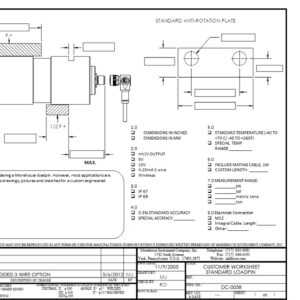
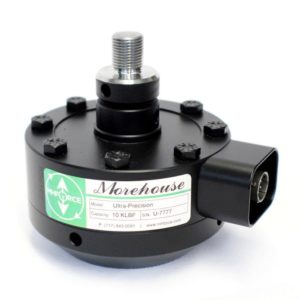
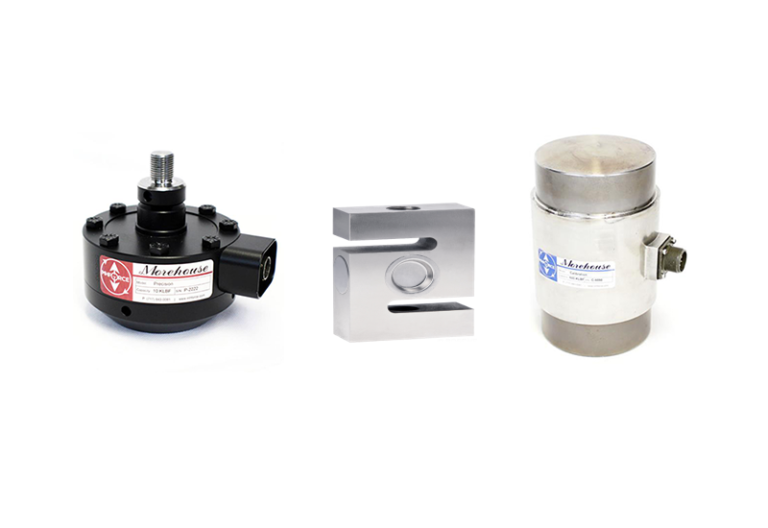
Nuclear plants often require instrumentation inside shielded enclosures, under piping manifolds, or near radiation-sensitive components—conditions where nuclear load measurement must remain accurate despite tight geometries. Morehouse manufactures compact, high-strength load cells designed to fit into extremely restricted spaces while maintaining full-scale accuracy. Custom thread geometry, connector orientation, and low-profile bodies mirror the design practices used in aerospace-grade load cells.
Calibration of Bolt Testers (Skidmore) for Containment and Structural Integrity
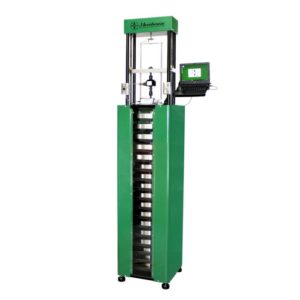
Morehouse provides ISO/IEC 17025-accredited calibrations for hydraulic and mechanical bolt testers, validating actual applied force rather than relying solely on pressure readings—an essential requirement for reliable nuclear load measurement in containment and structural systems. Calibration requires special fixtures based on factory recommendations. Many manufacturers use Morehouse directly for their standards as we use special adapters to best replicate tensioning a bolt.
Accuracy is typically 1% of the applied reading between 20–80% of the range, which will likely not be met without proper fixturing. These systems are typically used to test structural fasteners and torque/tension relationships.
Deadweight Calibrations for the Highest Nuclear Traceability
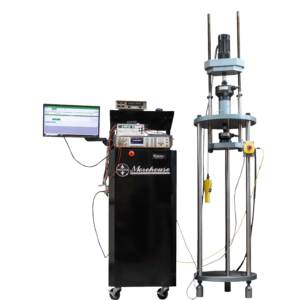
When nuclear safety-related components require the lowest possible uncertainty, Morehouse deadweight machines provide the gold standard for nuclear load measurement, offering:
-
Direct SI-traceable force realization
-
Uncertainties far below typical commercial calibration
-
Repeatability suitable for safety-critical measurements
Deadweight calibration is the definitive method for nuclear metrology programs requiring unmatched defensibility, similar to aerospace and turbine applications that demand ultra-low uncertainty.
Custom Load Cells for Large-Scale Weighing — Including Reactor Vessels
Morehouse designs and builds custom load cells for some of the largest and heaviest components in industrial environments, including applications where nuclear load measurement is essential:
-
Reactor vessels
-
Fuel transfer systems
-
Spent fuel pools and handling equipment
-
Crane and hoist load monitoring
-
Cooling tower structural loads
-
Containment dome lifting systems
Our experience designing million-pound-capacity load systems for energy and industrial clients applies directly to full-scale nuclear load measurement and structural weighing.
Systems can be configured with:
-
Multi-column load cells
-
High-capacity shear webs
-
Multi-axis pins for off-axis load compensation
-
Custom adapters enabling uniform height for multi-point weighing
We provide STEP files, control drawings, and full engineering collaboration to integrate sensors into tight or safety-critical nuclear assemblies.
System-Level Calibration Replicating Real-World Nuclear Conditions
Nuclear environments introduce complex variables that directly impact nuclear load measurement reliability:
-
Temperature gradients
-
Radiation-driven material changes
-
Long-term static loading
-
Highly constrained load paths
As with renewables and aerospace applications, laboratory accuracy alone can be misleading — field conditions may produce 2–3× higher uncertainty without proper MU modeling.
Morehouse calibrates the entire measurement chain to ensure accurate nuclear load measurement under real-world operating conditions:
-
Sensor
-
Indicator
-
Cables
-
Fixtures
-
Adapters
This ensures the data used for reactor lifts, pressure-boundary inspections, and safety-related monitoring reflects the actual operating tolerances required.
Why Nuclear Teams Choose Calibration-First
-
Compact, custom load cells for shielded or inaccessible locations supporting precise nuclear load measurement
-
Bolt tester calibration for containment and pressure boundaries
-
Deadweight force realization for nuclear-grade accuracy and defensible nuclear load measurement
-
Traceable MU modeling for regulatory defensibility
-
Large-capacity custom weighing systems for reactor vessels and heavy-lift operations requiring high-accuracy nuclear load measurement
-
ISO/IEC 17025 traceability through NIST, meeting nuclear QA and compliance frameworks
-
Audited by NUPIC
-
10 CFR Part 21 Compliant
When to Bring Morehouse In
- You require traceable load data for reactor lifts or vessel weighing
- Bolt tension readings are inconsistent or require regulatory audit documentation
- Your current calibration vendor cannot replicate your in-use conditions
- You need compact sensors to fit inside shielding or restricted areas
- You require the lowest possible uncertainty through deadweight calibration
- Legacy load cells or adapters no longer correlate between outages
- You are developing custom fixtures or monitoring systems for safety-related operations
Nuclear Needs better Force and Torque Measurements!
Morehouse delivers nuclear-grade, calibration-first accuracy — from reactor vessel weighing and containment bolt monitoring to spent fuel handling and heavy-lift validation, ensuring every nuclear load measurement meets the highest standards of reliability and traceability.
By combining system-level calibration, deadweight accuracy, compact and custom load cell design, and defensible uncertainty modeling, Morehouse ensures every nuclear load measurement is reliable, traceable, and compliant with nuclear QA standards.
If you want to know more about how Morehouse can help you make better measurements, Contact Sales
For more information or webinars on measurement risk and load cells, please visit our YouTube channel: https://www.youtube.com/@mhforcecalibration