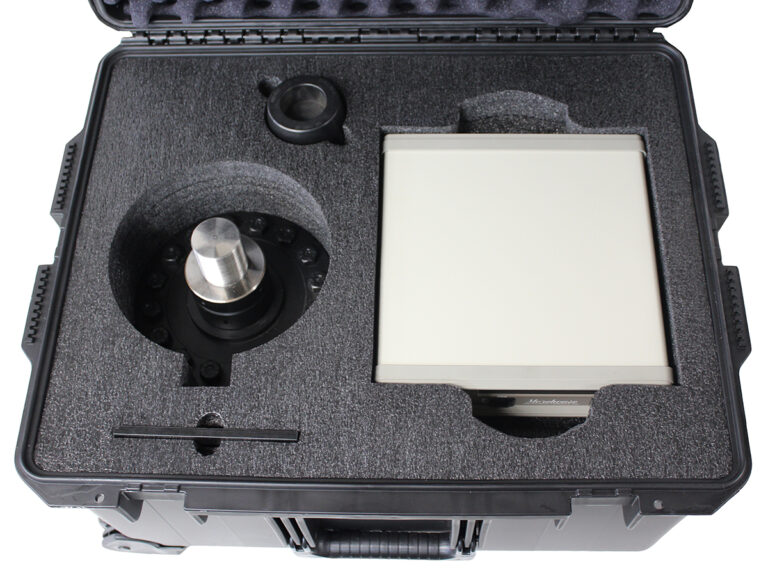

Why Automotive Teams Choose Calibration-First
- Vehicle Dynamics & Suspension: Accurate automotive load cell data for shock absorber, coil spring, and control arm testing under simulated road conditions.
- Crash & Safety Testing: Automotive load cell measurement systems for barrier and sled impacts with traceable calibration to ISO/IEC 17025.
- Powertrain & Drivetrain: Custom torque and axial force sensors for engine dynamometers, transmission, and e-mobility systems.
- Battery & EV Systems: Compression load calibration for cell stacking, module assembly, and cooling system integration.
- Component Testing: Applied measurement uncertainty models ensure consistency across endurance, fatigue, and lifecycle testing.
- Quality & Compliance: Guardbanded measurement uncertainty supporting ISO/TS 16949 and IATF 16949 quality frameworks.
When to Bring Morehouse In
- You need accurate, traceable measurement systems for vehicle testing or regulatory compliance.
- Your lab or production data varies between setups or facilities.
- Audit findings cite unclear traceability or missing measurement uncertainty data.
- You’re integrating new sensors or torque systems into EV or hybrid powertrain test benches.
- Your vendor cannot replicate your in-use conditions or provide system-level calibration.
- You require fast turnaround for ISO/IEC 17025 calibration to meet production schedules.
Custom Load Cells for Automotive Load Cell Applications
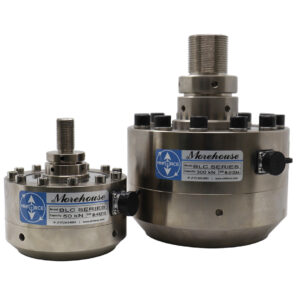
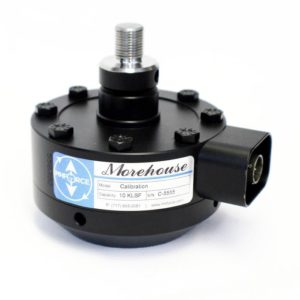
Morehouse designs and manufactures custom automotive load cells that meet the evolving demands of automotive and EV testing.
When standard load cells can’t achieve the necessary geometry, range, or environmental protection, our custom-engineered solutions ensure form, fit, and function are optimized for your test application.
Each load cell is modeled, machined, and calibrated in-house, ensuring predictable behavior under compression, tension, and torsional loads.
Designs are optimized for axle load, suspension link, and brake pedal force measurements, as well as battery compression and impact sled applications.
We provide STEP files, control drawings, and full CAD support for system integration.
Our engineers collaborate directly with your test and measurement teams to ensure compatibility, accuracy, and reduced setup time.
Safety and Environmental Adaptability
Automotive testing environments demand resilience against vibration, shock, and temperature extremes.
Morehouse automotive load cell solutions are designed with temperature compensation, mechanical isolation, and environmental sealing to maintain accuracy across dynamic testing.
We provide custom housings and strain-relief options for use in environmental chambers, wind tunnels, and trackside instrumentation.
Material and Performance Assurance
Material selection directly affects system reliability.
Morehouse engineers use 17-4PH, 15-5PH, and 440C stainless steels, or aluminum and titanium alloys where reduced mass and thermal stability are required.
Each design is validated through finite element analysis (FEA), system-level calibration, and mechanical testing that replicates real-world stress cycles.
Typical calibration performance targets — such as 0.05 % to 0.25 % full-scale error bands — are validated through high-precision test rigs.
These processes ensure data correlation across R&D, validation, and production environments.
Advanced Measurement Capability
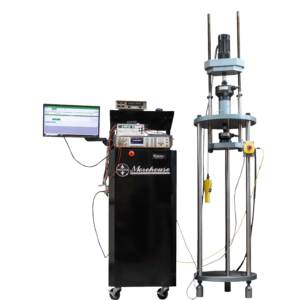
For complex automotive load cell applications, Morehouse engineers multi-axis load cells, torque transducers, and force measurement systems capable of measuring up to 2,250,000 lbf per axis.
For vehicle structural testing or battery pack compression, multiple 1,000,000–1,500,000 lbf sensors can be combined into a system with traceable calibration and applied uncertainty modeling.
These systems maintain cross-axis integrity and repeatability — ideal for chassis fatigue, axle bending, drive component validation, and battery crash simulation setups.
Applied Measurement Uncertainty (MU)
In automotive testing, a sensor that performs with 0.1% error in the lab may exhibit 2–3 times higher uncertainty under dynamic road or vibration conditions.
Morehouse develops applied MU models specific to your testing environment — quantifying total system error, including alignment, fixture stiffness, and dynamic load effects.
We replicate your in-vehicle or lab setups to ensure calibration results align closely with real-world performance.
What You Get
- System-Level Calibration replicating operational conditions
- Applied Measurement Uncertainty (MU) and decision rules for guardbanding
- ISO/IEC 17025 Certificates, traceable to SI through NIST
- Load Cell Modeling and Analysis by Morehouse engineering
- STEP Files and CAD Drawings for system integration
- Direct Technical Collaboration with engineers who understand vehicle testing
Examples of Load Cells Available
- Pedal Force Automotive Load Cells
- Suspension Link Automotive Load Cells
- Battery Compression Automotive Load Cells
- Torque Load Cells for Powertrain and E-Mobility
- Steering and Chassis Reaction Automotive Load Cells
- Multi-Axis and Combined Force Systems
- High-Capacity Column and Shear Web Load Cells
- Impact Test and Crash Simulation Automotive Load Cells
- Custom Engineered Automotive Measurement Systems
- And many others upon request
Automotive Load Cell Summary
Morehouse delivers calibration-first accuracy for the automotive industry — from R&D test labs and production facilities to crash and component testing.
We combine system-level calibration, custom load cell design, and traceable uncertainty modeling to ensure your data is accurate, repeatable, and compliant.
With fast turnaround, ISO/IEC 17025-accredited calibration, and direct collaboration with engineers, Morehouse helps automotive teams achieve measurement confidence at every stage of development.
Want more information about automotive load cells? View our YouTube videos on load cells.