

Do Load Cells Wear Out? What Ten Years of ASTM E74 Data Say About Load Cell Aging
In short: no, not the good ones. Across 16 703 deadweight ASTM E74 results on shear web cells, the median lower limit factor is 0.0055 % of capacity in the first year we see a cell and 0.0048 % eight to ten years later. For the 1 403 shear web cells we calibrated five or more years apart, the last LLF divided by the first has a median of 0.99, and the share that got worse by more than 20 % (37 %) is about the same as the share that got better by more than 20 % (35 %). That is not aging. That is noise, and a one-in-ten tail of cells that got dropped. S-beams are the exception, and the one place our own cells show a trend is small enough that I am going to show it and then argue with it.
The Question Nobody Has the Data to Answer
Every few weeks to months, time goes so fast for some of us that months now seem like weeks; someone asks us whether a load cell they bought in 2012 is still any good, or whether a cell gets more accurate as it "settles," or whether they should budget to replace their reference standard every so many years. The manufacturer, if pressed, says something about "long-term stability" with no number attached. The honest answer has always been that few labs can track deadweight calibrations on this many load cells over time. It requires calibrating the same cells against the same reference for a decade and keeping every number. We have been doing that since the 1980s, and our current database goes back to 2016. I used internal tools to pull that history into one large data file, then removed all identifying customer information. What remained was capacity, model number, and calibration data.
The population is the one from our buyer's guide: deadweight ASTM E74 calibrations only, 300 lbf to 120 000 lbf, sorted into shear web, column (or canister), and S-beam cells. Age is measured in two ways, because we only have one of them for everyone. For every cell, we know the date of its first calibration at Morehouse, which may not be its first calibration ever. That could influence the data, but we expect the impact to be small, based on cells where we do know the date of the first calibration. For our own shear web cells we can do better: the serial numbers are sequential, and that lets us estimate the year a cell was made.
Finding 1: The Shear Web Curve Is Flat
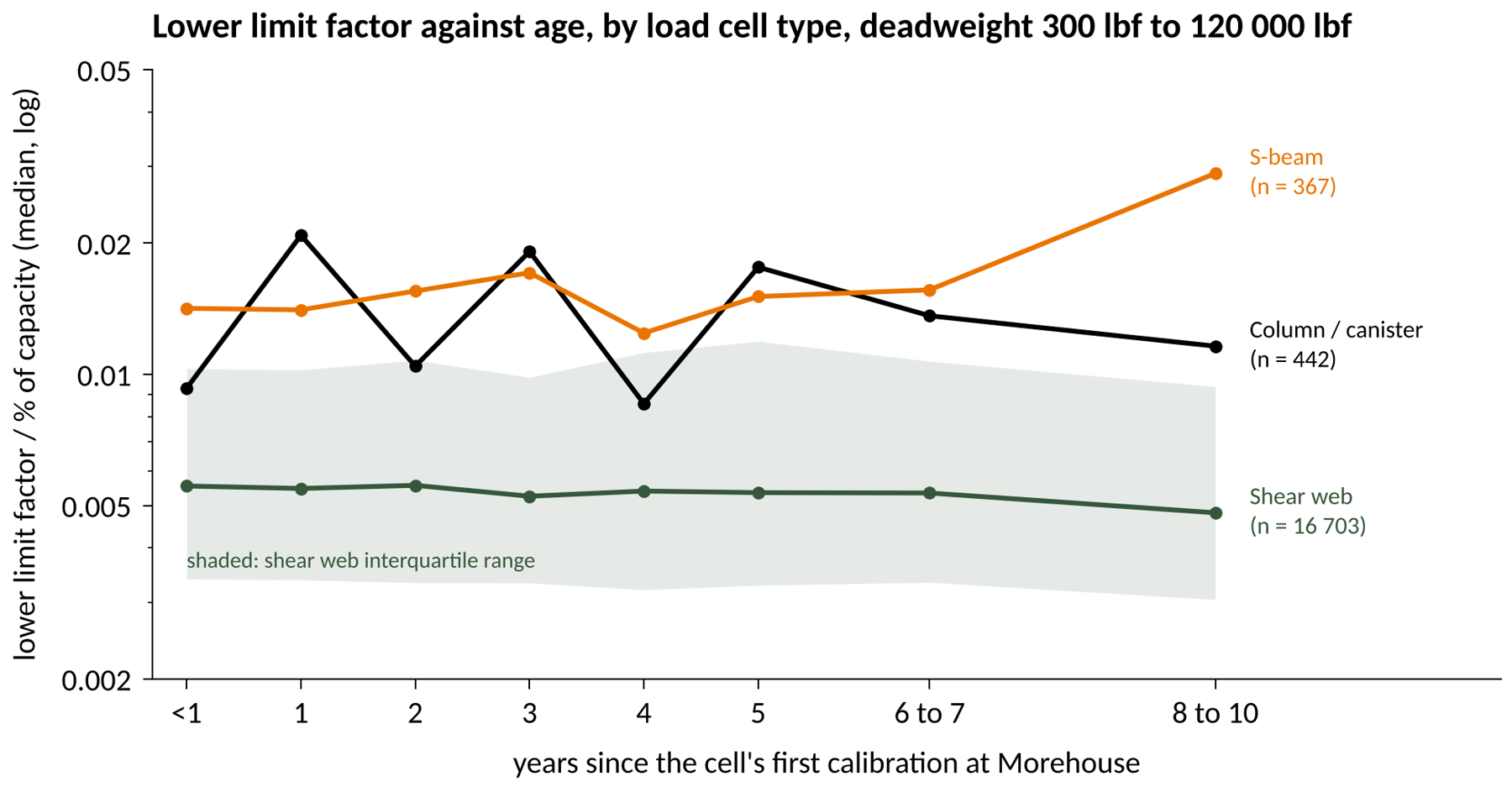
Figure 1. Median lower limit factor against years since the cell's first calibration at Morehouse, by type. The shaded band is the shear web interquartile range. Deadweight calibrations only, all indicators. Note the log scale.
Read the green line. Shear web cells calibrated in their first year at Morehouse have a median LLF of 0.0055 % of capacity. At three years, 0.0053 %. At five years, 0.0053 %. At eight to ten, 0.0048 %. The interquartile band does not widen. The share that reaches Class A from 10 % of capacity drifts from 94 % to 91 %, and the share at Class AA from 10 % goes the other way, from 45 % to 52 %. If you had told me in 2016 that the ten-year-old cells would have a slightly lower median than the new ones, I would have had my doubts. In my 17 to 20 years in the lab, I have seen great load cells that made for an easy weekend, and putrid ones where I questioned whether it was the same cell. Overall, I knew the shear web cells were likely to be a lot less hassle. Still, I would have expected their calibrations to stay about the same, with some drift creeping in over time. I would have argued for stability. What we are seeing instead is reproducibility getting slightly better over time. There is a reason, and it is in Finding 3.
The column cells are flat too, in their noisier way: 442 results, medians bouncing between 0.009 % and 0.02 % with no direction. The S-beams drift up, from 0.0142 % new to 0.0289 % at eight to ten years, on small numbers. More on that below.
Finding 2: The Same Cell, Five Years Later

Figure 2. For every shear web cell calibrated five or more years apart on deadweight (1 403 cells and directions), the last LLF divided by the first. Green, better by more than 20 %; black, within 20 %; orange, worse by more than 20 %. Log scale.
Figure 1 compares different cells at different ages, which invites the objection that the old cells we see are the survivors. Figure 2 answers it by following the same cell. For 1 403 shear web cells with five or more years between their first and last deadweight calibration, the median ratio of last LLF to first is 0.99. 35 % got better by more than 20 %, 37 % got worse by more than 20 %, and 28 % stayed within 20 %. Stretch the span to eight years or more and 586 cells give a median of 0.94: the same cell, eight years on, with a slightly lower LLF than the day we first saw it.
The symmetry is the finding. An LLF is 2.4 times the scatter in a dozen readings, so two calibrations of the same unchanged cell will disagree by a few tens of percent just from the arithmetic. If cells aged, the orange side of Figure 2 would be heavier than the green side. It is not. What the orange side does have is a tail: 17 % of cells at least doubled their LLF and 10 % at least tripled it. Those are not cells getting old. Those are cells that met an overload or a loose adapter, and the certificate caught it. Aging is gradual and shows up as a shift in the middle of the distribution. Damage is sudden and shows up as a tail. Our shear web population has the tail and not the shift.
The other two types, on fewer cells: 50 column cells calibrated three or more years apart have a median ratio of 0.96, flat again. 63 S-beams have a median ratio of 1.32, with 52 % worse by more than 20 % against 35 % better. That is a shift, not a tail, and it is the one type in our data that looks like it ages. I suspect the mechanism is the one from the pancake-versus-S-type article: an S-beam is loaded through its threads, every calibration is a slightly different loading condition, and thread wear accumulates. But 63 cells is enough to notice and not enough to be sure.
Finding 3: Our Own Cells, by the Year They Were Built

Figure 3. Morehouse shear web cells only, median LLF by the cell's estimated age at calibration, with age estimated from the serial number. Black, every calibration; green, only calibrations read in mV/V on a reference indicator. Counts are results in each bin.
For our own cells the age is real, not a lower bound, and the oldest cohort in the deadweight population dates from around 2012. On every indicator the line is as flat as Figure 1: 0.0047 % under a year old, 0.0046 % at five to eight years, 0.0043 % at eight to twelve. The share at Class AA from 10 % rises with age, from 54 % to 57 %. That is the survivor effect, and it is worth naming rather than hiding: a cell that comes back for its tenth calibration is a cell somebody has been looking after, on the same indicator, with the adapter still locked in. The cells that got overloaded in year two are not in the eight-to-twelve bin because they are in a drawer.
The green line is the one that made me look twice. Restrict to calibrations read on a reference indicator, and the older cohorts drift up: 0.0053 % under a year, 0.0071 % at three to five, 0.0102 % at eight to twelve. The last point is 47 results on 25 cells, so it is a hint, not a verdict. I can think of two explanations and the data do not yet separate them. One is real: a cell used as a laboratory reference standard for a decade has carried more load, more often, than a cell that lives in a drawer between annual checks. The other is selection: a customer who puts a ten-year-old cell on a 3458A is often a customer who has started to wonder about it. We are going to pull those 25 cells and read their histories one at a time, and I will report what we find either way.
What This Does Not Tell You
- Ten years, not a lifetime. The records we pulled from start in 2016. The oldest cell we can date was built around 2012.
- Survivors only. Every cell in the older groups came back to us for calibration. Cells that were thrown out, lost, or quietly retired after a bad year are missing. Those are the cells that could make the curve bend upward. Figure 2 helps with this because it tracks the same cells over time, but it cannot fully fix
- We only know the true age of our own cells. A cell made by another company might first show up at Morehouse in 2018 but have been built in 2008. That means those cells are really older than Figure 1 shows. So the flat shear web line is even more impressive, not less.
- It is the LLF, not the sensitivity. A cell's output can slowly shift by 0.05 % a year and still keep a perfect LLF. That is because the LLF measures how much the readings scatter around the fitted curve, not where the curve sits. Our 2023 reliability paper covered that kind of drift. This article asks a different question: is the cell still a precision tool? The answer is yes. A well-built cell's shape does not forget how to do its job.
What to Do With This
If you own a shear web cell with its adapter locked in and a clean calibration record, keep it. Keep calibrating it, and stop worrying about how old it is. Replace it when a certificate tells you to, not when a calendar does. If you own an S-beam, compare the LLF on each new certificate to the last one, because that is the type that changes over time. If you are buying, a used shear web cell with two certificates in a row is a safer bet than a new one with only a datasheet. Now you have the numbers to back that up. If you run a lab, this took one database search and an afternoon. The cells you calibrated in 2016 are still coming back. Check how they are doing.
Do Load Cells Wear Out? What Ten Years of ASTM E74 Data Say About Load Cell Aging Conclusion - About Morehouse
We believe in changing how people think about Force and Torque calibration in everything we do, including, "Do Load Cells Wear Out? What Ten Years of ASTM E74 Data Say About Load Cell Aging"
This includes setting expectations and challenging the "just calibrate it" mentality by educating our customers on what matters and what may cause significant errors.
We focus on reducing these errors and making our products simple and user-friendly.
This means your instruments will pass calibration more often and produce more precise measurements, giving you the confidence to focus on your business.
Companies around the globe rely on Morehouse for accuracy and speed.
Our measurement uncertainties are 10-50 times lower than the competition, providing you with more accuracy and precision in force measurement.
We turn around your equipment in 7-10 business days so you can return to work quickly and save money.
When you choose Morehouse, you're not just paying for a calibration service or a load cell.
You're investing in peace of mind, knowing your equipment is calibrated accurately and on time.
Through Great People, Great Leaders, and Great Equipment, we empower organizations to make Better Measurements that enhance quality, reduce risk, and drive innovation.
With over a century of experience, we're committed to raising industry standards, fostering collaboration, helping with understanding risk, and delivering exceptional calibration solutions that build a safer, more accurate future.
Contact Morehouse at info@mhforce.com to learn more about our calibration services and load cell products.
Email us if you ever want to chat or have questions about a blog.
We love talking about this stuff. We have many more topics other than, "Do Load Cells Wear Out? What Ten Years of ASTM E74 Data Say About Load Cell Aging"
Our YouTube channel has videos on various force and torque calibration topics here.