

Custom High Temperature Load Cells for Downhole Applications Above 400 °F (204 °C)
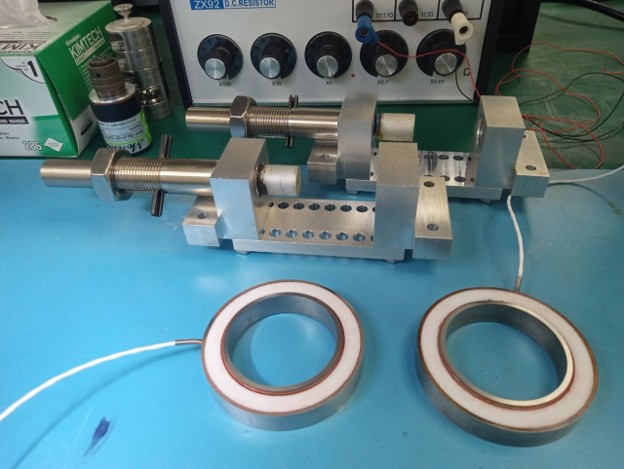
Donut-style (through-hole) high temperature load cells and compression fixtures on the bench at Morehouse.
Put a cast-iron skillet with a plastic handle into a 450 °F (232 °C) oven. The pan will be fine. The handle will not. A strain gauge load cell fails the same way. The steel element shrugs off the heat; the gauge backing, the adhesive, the wiring, and the potting do not. That difference is the starting point for every high-temperature load cell we build.
In the oil and gas world, these instruments are called downhole products. The name fits. The hardware lives where the temperature passes 400 °F (204 °C) and stays there, under pressure, for months at a time. These applications do not fit a catalog. Most of the interesting ones never do. Morehouse has built metrology-grade force instruments for 100 years, with over 25 years of experience with specialized load cells.
What "high temperature load cell" really means for a load cell
Most catalog load cells are compensated from roughly 60 °F to 160 °F (16 °C to 71 °C) and begin reading erratically above about 175 °F (79 °C). The load-bearing element is rarely the limit. The non-metallic parts are: the gauge backing, the bonding adhesive, the wire insulation, the solder, and the potting. When heat softens the adhesive, strain no longer transfers cleanly from the element to the gauge, and the output becomes a number you cannot defend.
Push past that point and the materials list changes. Polyimide-backed foil gauges hold to about 392 °F (200 °C) in continuous service. Above 400 °F (204 °C), the design moves to specialty gauge systems, inorganic or ceramic bonding, hermetically sealed housings, and cable built for the soak. Each choice affects three things you care about: temperature effect on zero, temperature effect on output, and creep. A cell designed for the heat controls all three. A catalog cell pushed past its rating controls none of them.
Why a donut load cell
A donut load cell (also called a through-hole load cell, ring load cell, or load washer) puts the hole where the force is. The bolt, stud, rod, or tool string passes through the center, and the cell measures the axial force directly at the joint in a compact, low-profile package.
That geometry earns its keep in downhole and aerospace work. Bolt preload on a hot joint does not stay where you left it; nickel-alloy fasteners relax and creep as the temperature climbs. Measuring the clamping force at the joint beats assuming it. The two cells in the photo above are this type: the load path passes straight through the bore.
What changes above 400 °F (204 °C)
How hot does the cell soak, and for how long? Is the load static, or does it cycle? What pressure and media surround it? Each answer moves the design.
The oil and gas industry has names for this territory. Wells above 300 °F (149 °C) are classified as high pressure, high temperature (HPHT), and wells above 400 °F (204 °C) or 20 000 psi (138 MPa) as ultra-HPHT. We bring over 25 years of experience with specialized load cells to that territory. Getting a cell there takes gauge systems rated for the soak, thermal compensation matched to the working range, hermetic sealing against pressure and media, and lead wire that survives the trip.
A custom high temperature load cell is only as good as its calibration
Plenty of shops can machine a ring and bond gauges to it. The difference shows up after the build. Every custom load cell we make is calibrated in-house on Morehouse deadweight primary standards: machines that apply force through calibrated masses corrected for local gravity and air buoyancy. Our deadweight machines apply force with an expanded uncertainty of 0.002 % of applied force (k = 2, approximately 95 % coverage probability). That can be 10 to 50 times lower than the uncertainty of a typical calibration performed with secondary standards.
Why does that matter for a sensor that will spend its life above 400 °F (204 °C)? Because every downstream claim about your process rests on the calibration baseline. Uncertainty is the quantified doubt in a measurement result, and it never gets smaller as conditions get harsher. Start with a low-uncertainty baseline and you preserve margin for the thermal effects the environment will add. Start with a sloppy baseline and the heat only compounds the doubt. Morehouse Instrument Company is ISO/IEC 17025 / ANSI/NCSLI Z540.3 accredited.
Adapters built for washer load cell calibration
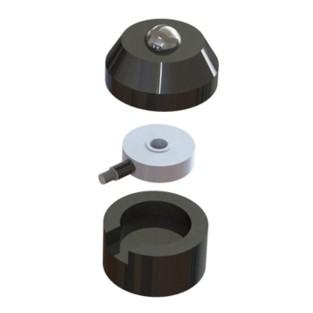
A washer load cell is only as easy to calibrate as its setup allows. Small washer cells are notorious for misalignment errors and reading changes between rotations. We machine miniature washer load cell adapter sets to solve this: a top alignment fixture with a loading ball keeps the force on the loading line, a base adapter holds the cell centered and stable through the run, and an optional alignment plug lines the setup up with the loading line of the calibrating machine. The result is a more stable setup, improved repeatability between runs and rotations, and less time on the machine. Adapter sets have been designed for numerous washer load cell models on the market, and every adapter carries a rust-resistant black oxide coating.
What to send us
Custom does not mean complicated. Send us:
- Capacity and load direction in lbf (or N): compression, tension, or both
- Operating temperature and soak duration
- Pressure and the media the cell will see
- Bore diameter, outside diameter, and height limits
- Mounting details, cable exit, routing, and length
- Your accuracy requirement and how you plan to use the data
We review the requirements, tell you what is achievable, and quote the build with calibration included. If a catalog part genuinely solves your problem, we will say that too.
Common questions
What temperature can a load cell/high temperature load cell withstand? Standard cells read erratically above about 175 °F (79 °C). Purpose-built high temperature load cells operate above 400 °F (204 °C), and specialty gauge systems extend further. The practical limit is set by the gauge, bonding, and wiring materials, not by the metal element.
What is a donut load cell used for? Measuring axial force where a bolt, stud, rod, or tool string passes through the cell: fastener preload, clamping force, and through-rod tension or compression in tight envelopes.
How is a high temperature load cell calibrated? On deadweight primary standards at reference conditions, with thermal effects on zero and output characterized over the working range so the data you collect at temperature is defensible.
Talk to Morehouse about High Temperature Load Cells
100 years of metrology-grade force instruments. Over 25 years of experience with specialized load cells. If your application doesn't fit a catalog, talk to Morehouse. Call (717) 843-0081 or email sales@mhforce.com and send us the parameters above. We will tell you, plainly, whether we can build it and how well we can calibrate it.
About Morehouse
We believe in changing how people think about Force and Torque calibration in everything we do, including, "High Temperature Load Cells"
This includes setting expectations and challenging the "just calibrate it" mentality by educating our customers on what matters and what may cause significant errors.
We focus on reducing these errors and making our products simple and user-friendly.
This means your instruments will pass calibration more often and produce more precise measurements, giving you the confidence to focus on your business.
Companies around the globe rely on Morehouse for accuracy and speed.
Our measurement uncertainties are 10-50 times lower than the competition, providing you with more accuracy and precision in force measurement.
We turn around your equipment in 7-10 business days so you can return to work quickly and save money.
When you choose Morehouse, you're not just paying for a calibration service or a load cell.
You're investing in peace of mind, knowing your equipment is calibrated accurately and on time.
Through Great People, Great Leaders, and Great Equipment, we empower organizations to make Better Measurements that enhance quality, reduce risk, and drive innovation.
With over a century of experience, we're committed to raising industry standards, fostering collaboration, helping with understanding risk, and delivering exceptional calibration solutions that build a safer, more accurate future.
Contact Morehouse at info@mhforce.com to learn more about our calibration services and load cell products.
Email us if you ever want to chat or have questions about a blog.
We love talking about this stuff. We have many more topics other than, "High Temperature Load Cells"
Our YouTube channel has videos on various force and torque calibration topics here.