

Common Compression Force Calibration Setups: Keeping the Load Line Pure
Common Compression Force Calibration Setups: Keeping the Load Line Pure Intro
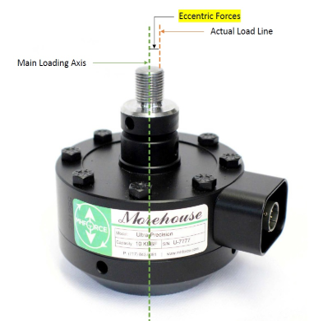
A load cell that reads to 0.005 % of full scale on the bench can degrade to 0.5 % of full scale, or worse, once it is mounted with the wrong hardware. Same cell. Same electronics. The only thing that changed was the setup.
One way to describe this is that the calibration laboratory determines the expected performance of the load cell at the time of calibration. Anything that is done differently, immediately afterward, which includes an allowance for stability, derates the load cell performance. Different temperatures, different setups, different machines that are not as still, or are less level. There are so many variables here, which makes it sense to reduce many of these by standardizing the loading conditions and adapters.
That gap is the whole subject of this post. Force calibration looks simple from the outside: apply load, read the cell, write the certificate. In practice, the compression force calibration setup decides whether the number on that certificate reflects what the cell will actually do for the next twelve months.
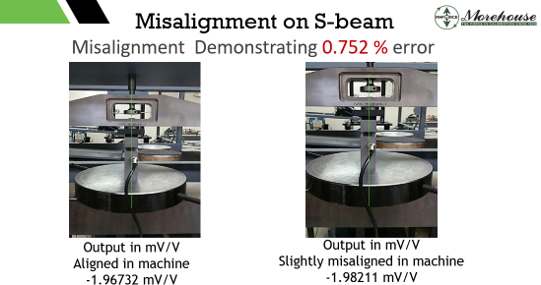
Why does the setup matter so much? Consider what a compression cell is being asked to do. It measures force along one axis. Any load that arrives off that axis, from bending, side loading, or torsion, shows up as an error; the cell cannot separate it from the real force. In our lab, misalignment between the load cell and the load line of as little as 0.005 in produced an error of 0.752 % of the applied force on a 10 000 lbf (44.5 kN) compression cell. That is roughly 75 lbf (334 N) at full scale, an order of magnitude larger than the cell's own nonlinearity spec.
So, the job of a good compression setup is narrow and specific: keep the line of force pure, and reproduce how the cell is actually used.
The reference standard setup comes first
Every compression calibration is a comparison against a reference standard, so the reference stack is where alignment starts. On a Morehouse Universal Calibrating Machine (UCM) up to 200 000 lbf (890 kN), the reference standard stacks as: ball seat adapter (UC-xxx-51) to load ball adapter (CCE-1) to the reference standard load cell to alignment plug (CA) to jack compression block (UC-xxx-50) to the hydraulic jack. The ball seat and load ball let the load self-center; the alignment plug threads into the cell and centers it in the machine.
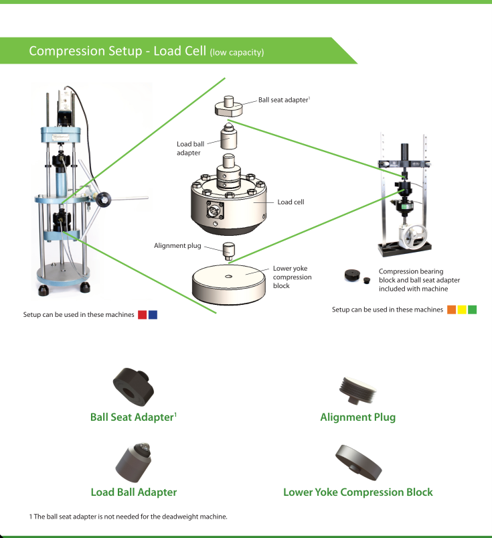
Reference standard compression setup on a UCM, shear-web load cell.
The low-capacity load cell setup
Below the reference standard sits the unit under test. For a low-capacity compression cell the stack is: ball seat adapter to load ball adapter to load cell to alignment plug to lower yoke compression block (UC-xxx-052). The compression bearing block and ball seat adapter ship with the machine. The pattern repeats the reference stack for a reason: what centers the standard also centers the unit under test.
Send your top block
Here is the single most valuable habit in compression work, and it costs nothing. When you send a load cell in for calibration, send its top block too.
Why? Because the top block is part of the measurement. Changing only the top-block hardness, Rockwell C 20 versus C 55, on the same compression cell shifted the indicated force by approximately 0.5 %. Nothing about the cell or the machine changed. The adapter alone moved the reading by five times what many cells are specified to deliver.
An integral top block that matches the field setup, such as the CG-1 family, typically reduces the lower limit factor (LLF) by 30 % to 40 % versus an arbitrary loading button. That is a direct improvement in the cell's usable range, gained without touching the cell.
The illustration below shows the two ways this plays out. Setup 1 is used when the customer does not send a block: a top compression alignment block (CG-10) with an upper alignment bushing plate (CG-15). Setup 2 is best practice: the customer's own block, calibrated with a CG-1. Both run the load cell to the alignment plug to the lower yoke compression block.
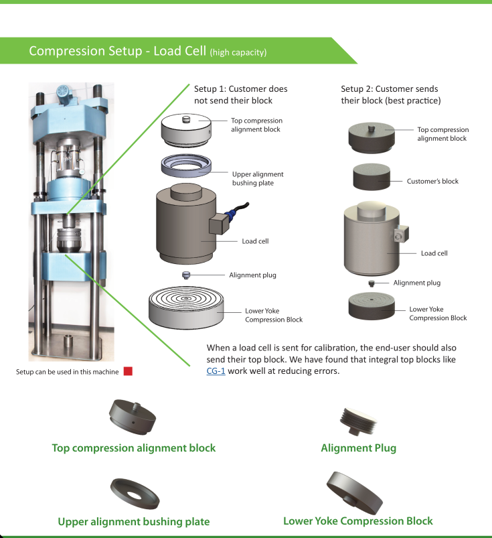
Compression setup, high-capacity load cell. Setup 1 (no customer block) versus Setup 2 (customer sends their block, best practice).
The setup without an integral adapter
Not every cell has an integral top block. When it does not, the compression setup runs from the top compression alignment block with a straight edge (CG-1) to a spherical load button (CB series) to the load cell. The spherical button gives the load a single, repeatable contact point and lets small angular misalignments resolve instead of turning into a bending moment. Watch the button for wear: any unusual rotation on the load button is grounds for immediate replacement, because a worn button no longer seats where it did when the cell was calibrated.
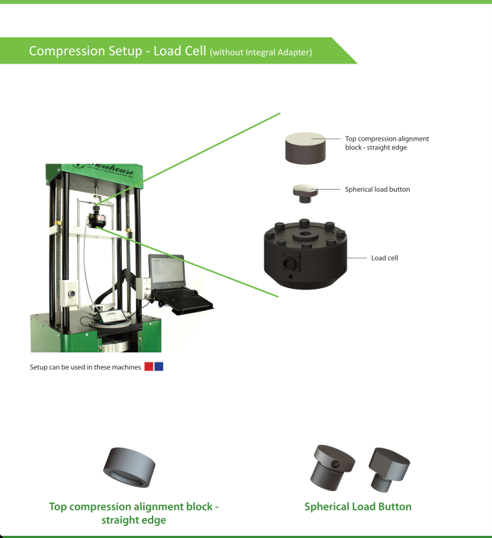
Compression setup without an integral adapter: top alignment block to spherical load button to load cell.
Four habits that hold across every compression setup
- Install the adapter correctly for the loading path. If the cell is loaded through its body, screw the spherical load button in fully until the shoulder is tight against the body. If it is loaded through its threads, back the adapter off one full turn so it does not touch the body. (Thread-loaded setups can still carry some residual error, but it is typically much lower than when thread engagement length varies between setups.)
- Center before you load. Thread the alignment plug (CA) into the cell and confirm the load line is concentric before applying any force.
- Seat, then run. Bring adapters hand-tight, apply a light preload to seat the stack, and keep it square and free of side loading.
- Replicate the application. Talk to the end user and match thread engagement, top-adapter hardness and flatness, and pin size. The certificate should reproduce how the instrument is used, not how one convenient setup happened to behave.
The cost of getting this wrong does not stop at the certificate. A 0.1 % adapter-induced shift on a cell used 1 000 times per year is 1 000 measurements made against the wrong reference, and in a lab making conformance decisions that collapses your test uncertainty ratio and drives up the probability of false accept. The fix is inexpensive by comparison. Match the field condition, keep the load line pure, and let the certificate mean what it says. If you are not sure which compression adapters your machine and your cell require, talk to us before you order. The right setup pays for itself the first time it keeps a good part from being scrapped, or a bad one from shipping.
And this is just a small post to raise awareness of how important compression force calibration setups can be. Our force calibration book is over 400 pages and free to download.
Common Compression Force Calibration Setups: Keeping the Load Line Pure Outro
About Morehouse
We believe in changing how people think about Force and Torque calibration in everything we do, including, "Common Compression Force Calibration Setups: Keeping the Load Line Pure"
This includes setting expectations and challenging the "just calibrate it" mentality by educating our customers on what matters and what may cause significant errors.
We focus on reducing these errors and making our products simple and user-friendly.
This means your instruments will pass calibration more often and produce more precise measurements, giving you the confidence to focus on your business.
Companies around the globe rely on Morehouse for accuracy and speed.
Our measurement uncertainties are 10-50 times lower than the competition, providing you with more accuracy and precision in force measurement.
We turn around your equipment in 7-10 business days so you can return to work quickly and save money.
When you choose Morehouse, you're not just paying for a calibration service or a load cell.
You're investing in peace of mind, knowing your equipment is calibrated accurately and on time.
Through Great People, Great Leaders, and Great Equipment, we empower organizations to make Better Measurements that enhance quality, reduce risk, and drive innovation.
With over a century of experience, we're committed to raising industry standards, fostering collaboration, helping with understanding risk, and delivering exceptional calibration solutions that build a safer, more accurate future.
Contact Morehouse at info@mhforce.com to learn more about our calibration services and load cell products.
Email us if you ever want to chat or have questions about a blog.
We love talking about this stuff. We have many more topics other than, "Common Compression Force Calibration Setups: Keeping the Load Line Pure"
Our YouTube channel has videos on various force and torque calibration topics here.
# Common Compression Force Calibration Setups: Keeping the Load Line Pure