

How to Calibrate a Crane Scale: Reproduce the Way it Hangs
A crane scale spends its working life hanging from a hook with a load swinging underneath it. Calibrate it any other way and the certificate describes a scale that does not exist.
That is the whole problem with crane scale calibration. The instrument is easy to load and easy to load badly, and overhead lifting is a safety application, so a wrong reading carries consequences well past the paperwork.
What a crane scale is actually measuring
A crane scale is a hanging scale that measures tensile force between a top fitting and a bottom hook and reports it on a digital display. It measures force along one line: the vertical line from the shackle at the top to the hook at the bottom. Anything that pulls that line off vertical, a cocked top fitting, a load that sways, arrives as bending the scale cannot separate from force. The reading moves and the scale has no way to tell you why.
So the job of a good setup is narrow and specific: hang the scale in pure tension, let it find its own axis, and load it through the same rigging it sees in the field.
Build the tension setup
A crane scale is calibrated in tension, in a machine that can apply and hold a smooth, controllable pull. On a Morehouse Universal Calibrating Machine up to 120 000 lbf (534 kN), the scale hangs between two tension members. Each tension member assembly (TMA) carries a clevis (TU) and pin: the top clevis takes the scale's shackle, the bottom clevis takes its hook. The built-in self-alignment of the tension member lets the load line settle straight instead of fighting the fixture. For crane scales at or below 10 000 lbf (44.5 kN), a benchtop machine with a single clevis pair handles the job on the bench.
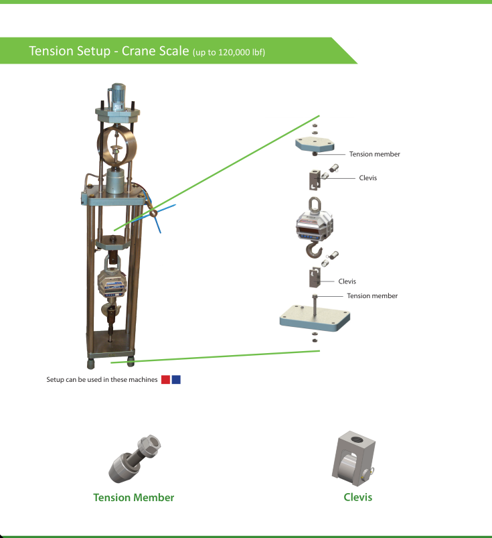
Crane scale tension setup on a UCM: the scale hangs between two tension members, each fitted with a clevis and pin.
Rig it the way it lifts
Here is where crane scale calibration gets muddled with tension link calibration, and the two are not the same instrument. A tension link is a flat body pinned through a hole at each end, so the pin diameter and fit sit directly in the load path. Swap that pin for one that is close but not identical and readings can move by more than a percent. A crane scale is built differently. It hangs from its own top fitting and carries the load on its own hook, and both are free to swivel and find the vertical. The specific shackle and pin matter far less, because the scale is not measuring through them the way a tension link does. What still matters is rigging it the way it lifts: hang it from the top fitting it uses in service and load it through its own hook, so the calibration reproduces the field setup rather than inventing a new one.
If the scale lifts through a specific shackle in service, that shackle belongs in the calibration. If it hangs from a hook, calibrate it hanging from that hook.
Hang it straight, then load it
Before recording anything, let the scale hang plumb and free so the load line is vertical. Exercise it to capacity two or three times to settle the mechanism and stabilize the output. Then run the points:
- Apply the reference force and let the scale settle so the load line is vertical and still.
- Read the display at each test point across the range the scale is actually used over, not just at capacity.
- Calibrate in the orientation the scale hangs in, with its own top fitting and hook in place.
- Repeat enough times to characterize repeatability. We typically take multiple readings per point to trust the numbers.
Read across the range, not only at capacity
Crane scales often work near the top of their range, so it is tempting to check only a high point. Resist that. A crane scale's error rarely behaves the same from bottom to top, and many are specified as a percentage of full scale, which makes a fixed error a larger share of a small reading. Take points across the range the scale is actually used over, low, middle, and high, so the certificate describes the whole working span and not one convenient corner of it. Resolution belongs here too: a scale that displays in 5 lbf steps cannot resolve finer than 5 lbf, and that step has to sit in the uncertainty budget.
State the result honestly
A crane scale reading is a force measurement, and it deserves a full uncertainty statement. Report the expanded uncertainty with its coverage factor and coverage probability, for example U = 0.1 % of reading, k = 2, approximately 95 % confidence. If you issue a conformity statement, state the decision rule and whether the scale's tolerance is met once uncertainty is accounted for: simple acceptance is defensible at a test uncertainty ratio of 4.6:1 or better, and a guard band is the honest tool when the ratio is tighter. A pass mark with no decision rule behind it is a pass mark with an asterisk the end user never sees.
Calibrate a crane scale the way it is used, in tension, hanging straight, on its own rigging, and it will earn its place in a lifting program. If you need a machine sized for your crane scale, or clevis and shackle fixtures matched to the way you lift, talk to us before your next calibration is due.
Want the full story behind every point here? Force versus mass, gravity corrections, tension link pin effects, loading conditions, and how to build an honest uncertainty budget are all covered in depth in our e-book, Force Calibration for Technicians and Quality Managers. Download it for the complete reference, and reach out when you are ready to calibrate your crane scale the right way.
About Morehouse
We believe in changing how people think about Force and Torque calibration in everything we do, including, "How to Calibrate a Crane Scale: Reproduce the Way it Hangs"
This includes setting expectations and challenging the "just calibrate it" mentality by educating our customers on what matters and what may cause significant errors.
We focus on reducing these errors and making our products simple and user-friendly.
This means your instruments will pass calibration more often and produce more precise measurements, giving you the confidence to focus on your business.
Companies around the globe rely on Morehouse for accuracy and speed.
Our measurement uncertainties are 10-50 times lower than the competition, providing you with more accuracy and precision in force measurement.
We turn around your equipment in 7-10 business days so you can return to work quickly and save money.
When you choose Morehouse, you're not just paying for a calibration service or a load cell.
You're investing in peace of mind, knowing your equipment is calibrated accurately and on time.
Through Great People, Great Leaders, and Great Equipment, we empower organizations to make Better Measurements that enhance quality, reduce risk, and drive innovation.
With over a century of experience, we're committed to raising industry standards, fostering collaboration, helping with understanding risk, and delivering exceptional calibration solutions that build a safer, more accurate future.
Contact Morehouse at info@mhforce.com to learn more about our calibration services and load cell products.
Email us if you ever want to chat or have questions about a blog.
We love talking about this stuff. We have many more topics other than, "How to Calibrate a Crane Scale: Reproduce the Way it Hangs"
Our YouTube channel has videos on various force and torque calibration topics here.