

Required Reading: Good to Great Leadership Lessons for Calibration Labs
“Good is the enemy of great.”
Jim Collins, Good to Great: Why Some Companies Make the Leap and Others Don’t
Most companies want to be good. Most calibration laboratories think they are good; some are not, and people can feel free to comment on horror stories they’ve experienced. Preferably without naming the company. They hold their accreditation, pass their assessments (not all ABs are equal), and keep their customers reasonably happy (we’ve had a lot of defectors from others lately, so maybe they don’t do this as much as they need to). That is exactly the problem. Good is comfortable, and comfortable companies rarely ask what it would take to become great.
Jim Collins asked that question with data, and the answers he published in Good to Great belong in the hands of every leader, manager, and technician who wants their organization to last. I have kept it on my list of five must-read books for more than a decade. It is likely the one book that did the most to change Morehouse’s strategy, and its language shows up in our meetings all the time: the bus, the hedgehog, the flywheel.
Its lessons are principles your company needs to know and act on. The rest of this article lays them out as leadership lessons for calibration labs and shows how each one applies to metrology.
Why the evidence demands attention
These lessons are not one executive’s opinion. Collins and his research team spent five years on the question. They started with 1435 companies that appeared on the Fortune 500 between 1965 and 1995 and searched for a specific pattern: 15 years of cumulative stock returns at or below the general market, a transition point, then 15 years of returns at least three times the market.
Only 11 companies made the cut. Each was paired with a direct comparison company in the same industry that had the same opportunities and failed to make the leap. The team also studied companies that rose briefly and then slid back.
The findings overturn much of what leaders assume. Executive compensation, mergers and acquisitions, technology, and change-management programs played a minor role. What separated great from good came down to people, starting with leadership, and to discipline in three stages: disciplined people, disciplined thought, and disciplined action.
Lesson 1: Greatness starts with Level 5 leadership
Collins describes five levels of leadership:
- Level 1: Highly capable individual
- Level 2: Contributing team member
- Level 3: Competent manager
- Level 4: Effective leader
- Level 5: Executive who builds enduring greatness through a paradoxical blend of personal humility and professional will
Every good-to-great company had a Level 5 leader during its transition. These leaders were fanatically driven toward results and wanted the company to keep performing long after they left. They gave credit to others when things went well and took the blame when they did not. Darwin Smith of Kimberly-Clark is the model: a shy, plain-spoken CEO who never cultivated a celebrity image and turned a mediocre paper company into a world leader.
Many comparison companies had the opposite: a larger-than-life CEO with no succession plan. When that leader left, the company often fell apart.
Metrology demands the same blend. A measurement result without a stated uncertainty is a claim of perfection. The metrologist who reports the uncertainty is admitting, in numbers, what is not known. That takes humility. Driving that uncertainty down, year after year, takes will. If your leadership team cannot say what it does not know, your laboratory will struggle to either.
Lesson 2: First who, then what
“If we get the right people on the bus, the right people in the right seats, and the wrong people off the bus, then we’ll figure out how to take it someplace great.” Collins found that the good-to-great companies settled the people question before they decided where to drive.
So, what do the right people look like?
The right people fit your company’s core values. They adapt and perform at a high level no matter what comes next, and they carry out the company’s vision without needing to be managed into it. Above all, they are disciplined. The good-to-great companies hired for character over specific skills, because skills can be taught. When they found the wrong person in a seat, they acted quickly, either moving that person to a better-suited role or off the bus. Waiting only frustrated everyone else.
Anyone who has trained calibration technicians knows this is true. You can teach someone to run an ASTM E74 calibration. It is much harder to teach someone to care whether the number is right.
Lesson 3: Confront the brutal facts
Disciplined people are the ones willing to face the brutal facts of reality. Collins calls the right mindset the Stockdale Paradox, after Admiral James Stockdale, a prisoner of war in Vietnam for more than seven years. Stockdale never lost faith that he would get home. He also never pretended he would be home by Christmas. The prisoners who did, Stockdale said, were the ones who did not make it. And none of them were losers for getting captured!
The good-to-great companies held both ideas at once: unwavering faith that they would prevail, and a clear view of their current situation. Their leaders asked questions instead of handing out answers. They studied mistakes without assigning blame, so that people would keep bringing bad news forward. They built what Collins calls red-flag mechanisms that made hard information impossible to ignore.
Every accredited laboratory already has red-flag mechanisms. They are called out-of-tolerance notifications, corrective actions, proficiency test results (You are not done until you prove that En is under one!), and customer complaints. Do you treat each one as a gift or as a threat? - Maybe you complain a little here and there, and then fix the problem. - That can be okay.
Is your root-cause investigation built to learn, or to find someone to blame? Would your technicians bring you bad news before an assessor finds it? Collins found that the good-to-great companies did not have better information than their competitors. They simply faced it more honestly.
Lesson 4: Find your Hedgehog Concept
Imagine a fox hunting a hedgehog. (The fox wants a meal. This vegetarian/vegan author is rooting for the hedgehog, did I lose my audience admitting I’m not a carnivore?, Okay I do miss spare ribs, does that give me an indeterminate pass or fail?) Every day the fox tries a new, cunning attack. Every day the hedgehog’s response is the same: curl up into a spiky, unbreachable ball. The hedgehog wins because it knows one big thing and sticks to it.
Collins’s Hedgehog Concept comes from three intersecting circles, each with its own question (Figure 1).
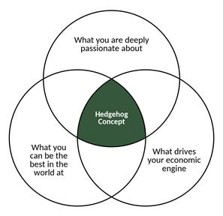
Figure 1. The Hedgehog Concept: the intersection of passion, best-in-the-world potential, and economic engine.
- What are you deeply passionate about? This applies to you as the leader and to your team.
- What can you be the best in the world at? This is not a goal to be the best. It identifies something you are already good at and can become great at with more effort, focus, or strategy. It is just as important to know what you cannot be the best at.
- What drives your economic engine? This is how you make money. Collins suggests a single denominator: profit per customer, per employee, per location, per region, or per product.
The intersection of the three answers is the Hedgehog Concept, and every decision in the company should follow it. It took the good-to-great companies an average of four years of iteration and debate to find theirs. Walgreens is Collins’s clearest example. It decided to be the best, most convenient drugstore, with high profit per customer visit. Anything that did not fit was simply not pursued.
If you cannot state your company’s Hedgehog Concept in a sentence, that is your first brutal fact.
Measurement confidence: a hedgehog for metrology
For calibration laboratories, the concept maps directly onto our work. Rename the hedgehog measurement confidence, and relabel the three circles (Figure 2).
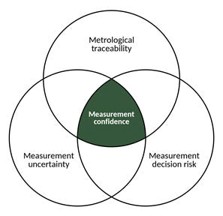
Figure 2. Measurement confidence as a Hedgehog Concept for calibration laboratories.
Is the measurement result traceable to the International System of Units (SI) through a National Metrology Institute (e.g., NIST) that is a signatory to the CIPM MRA? Has the measurement uncertainty been evaluated correctly and reported with its coverage factor and coverage probability? Does the conformity statement follow a documented decision rule that accounts for that uncertainty?
A laboratory that can answer yes to all three can instill real confidence in its measurements. Miss any one and the confidence is gone. Traceability without a sound uncertainty budget is only a paper trail. An uncertainty budget without a decision rule leaves the customer guessing what pass means. A decision rule built on a weak uncertainty estimate moves the risk to the end user without telling them.
Lesson 5: Push the flywheel
From the outside, the good-to-great transformations looked sudden and dramatic. From the inside, they felt like nothing special. There was no launch event, no slogan, and no change program. Each company pushed a heavy flywheel in one consistent direction, and each small push built momentum until the wheel was turning on its own.
Nucor is the example. After nearly going bankrupt in 1965, it realized it could make steel better and cheaper with mini-mills. It built one mini-mill, gained customers, built another, and kept going for more than two decades until it became one of the most profitable steel companies in the United States. The comparison companies lurched from one dramatic program or acquisition to the next and never let the flywheel gather speed.
Calibration laboratories grow the same way. An accreditation scope expands one parameter at a time, and if it doesn’t, well I hope you’ve hired experts that are all rowing together, otherwise, a major headache is probable. An uncertainty budget improves one contributor at a time. Stop looking for the one big initiative. Pick the direction and keep pushing.
Lesson 6: Use technology to accelerate, not to steer
The good-to-great companies never let technology decide their direction. They used it to accelerate a direction they had already chosen. When the dot-com boom hit, Walgreens took a beating on Wall Street for moving too slowly online. Rather than panic, it asked how the internet could make the drugstore more convenient and raise profit per customer. The answer, Walgreens.com with online prescription refills, fit its Hedgehog Concept.
Of all the leadership lessons for calibration labs in the book, this one could not be more timely. Laboratories are being pushed toward automation, new software, and artificial intelligence. Before adopting any tool, ask one question: does it accelerate measurement confidence?
Lesson 7: Build a culture of discipline around core values
After we studied these principles at Morehouse, we wrote our vision, mission, and core values. I wish I could say we did it once and got it right. Like the companies Collins studied, we found the first draft comes quickly, and the refinement takes years. Our current core values are a refinement of where we started, and they are much stickier than earlier versions. Our mission has stayed simple: we create a safer world by helping companies improve their force and torque measurements.
Core values are the fundamental beliefs held by a person or an organization. They guide behavior within the group and help people tell right from wrong. Engagement is much easier to achieve when core values are realized rather than just looking good on the wall. Realization is when the organization is firing on all cylinders. Everyone understands the values and knows how to apply them. They are discussed often, and you can find them in the strategy and in daily decisions.
Collins treats core values more fully in his earlier book, Built to Last. In Good to Great he focuses on the culture that surrounds them: a culture of discipline and a culture of truth, built by leadership rather than enforced by a tyrant.
Greatness has to be maintained
Good to Great was published in 2001, and not every company in it stayed great. Circuit City went out of business in 2009. Fannie Mae was placed into government conservatorship in 2008. Walgreens, the poster child for the Hedgehog Concept, struggled for years and was taken private in 2025. Collins addressed this in a later book, How the Mighty Fall.
That history makes these leadership lessons for calibration labs more urgent, not less. A Hedgehog Concept is not a trophy you win once. The companies that slipped stopped confronting the brutal facts or wandered outside their circles. Anyone in metrology already understands this: a calibration is only a snapshot in time. Greatness works the same way.
Make it required reading for your team
These are the leadership lessons for calibration labs, and for any company that wants to be great: Level 5 leadership, the right people in the right seats, the courage to face brutal facts, a clear Hedgehog Concept, a patient flywheel, technology as an accelerator, and a culture of discipline. Not every company that attempts the leap will make it. The ones that do know exactly who they are, who belongs on the bus, and what they will not do.
Buy a copy of Good to Great for your leadership team. Make it required reading. Then sit down together, draw your three circles, and start pushing the flywheel.
Oh, and start it now, as it’s not a poster on the wall rah-rah journey. It’s a foundational system that takes quite a bit of time to master. We’ve been at it for about a decade, and continue to refine and adapt. We are not masters, though we will be better tomorrow than we are today.
-Henry Zumbrun, CEO, Morehouse Instrument Company
About Morehouse
We believe in changing how people think about Force and Torque calibration in everything we do, including, "Leadership Lessons for Calibration Labs"
This includes setting expectations and challenging the "just calibrate it" mentality by educating our customers on what matters and what may cause significant errors.
We focus on reducing these errors and making our products simple and user-friendly.
This means your instruments will pass calibration more often and produce more precise measurements, giving you the confidence to focus on your business.
Companies around the globe rely on Morehouse for accuracy and speed.
Our measurement uncertainties are 10-50 times lower than the competition, providing you with more accuracy and precision in force measurement.
We turn around your equipment in 7-10 business days so you can return to work quickly and save money.
When you choose Morehouse, you're not just paying for a calibration service or a load cell.
You're investing in peace of mind, knowing your equipment is calibrated accurately and on time.
Through Great People, Great Leaders, and Great Equipment, we empower organizations to make Better Measurements that enhance quality, reduce risk, and drive innovation.
With over a century of experience, we're committed to raising industry standards, fostering collaboration, helping with understanding risk, and delivering exceptional calibration solutions that build a safer, more accurate future.
Contact Morehouse at info@mhforce.com to learn more about our calibration services and load cell products.
Email us if you ever want to chat or have questions about a blog.
We love talking about this stuff. We have many more topics other than, "Leadership Lessons for Calibration Labs"
Our YouTube channel has videos on various force and torque calibration topics here.