

Pancake Load Cell vs S-Type Load Cell: What Over 11 000 Calibrations Say About Which One to Buy
In short: on deadweight ASTM E74 calibrations from 300 lbf to 120 000 lbf, the pancake (shear web) load cell runs at a median lower limit factor of 0.005420 % of capacity and the S-type (S-beam) at 0.01447 %, nearly three times higher. Four pancake cells in five are Class A from 5 % of capacity; two S-types in five are. If the cell is going to be a reference standard, buy the pancake. If it is going to hang in a tension line and get looked at twice a year, the S-type is fine and costs a fraction. The numbers below are the evidence.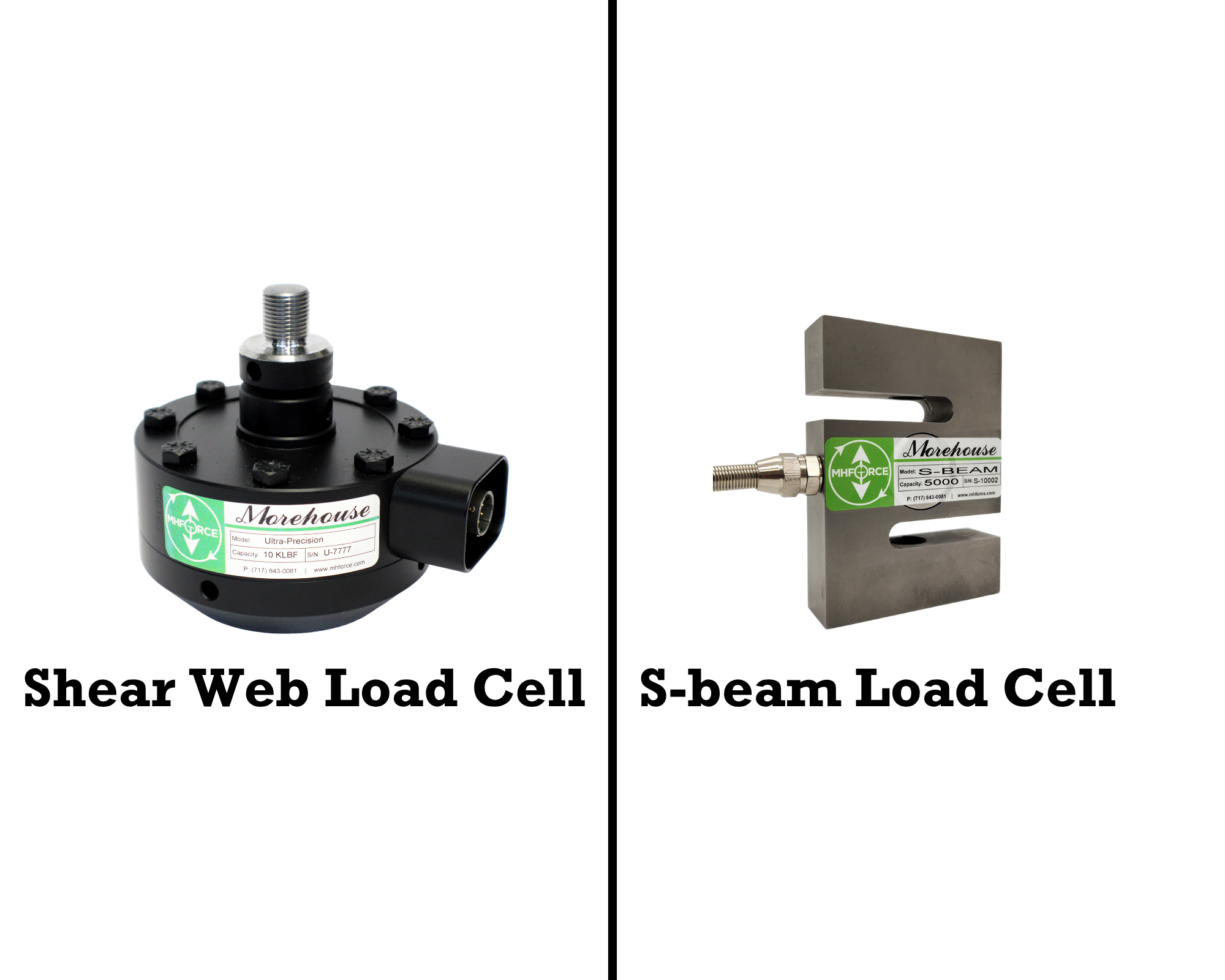
Two Shapes, Two Jobs, One Question
A pancake load cell is a flat disc with a threaded hole in the middle and a ring of bolts around the edge. Inside it, the load is carried by thin spokes loaded in shear, which is why the precision labs call it a shear web cell. An S-type cell is shaped like the letter: load goes in the top thread, out the bottom thread, and the middle bar bends. Both are strain gauge load cells. Both come with a datasheet that says 0.02 % or 0.03 % of something. And every week somebody asks us which one to buy for calibrating their press, their test frame or their crane scale.
The datasheet cannot answer that, because a datasheet describes the day the cell shipped. A calibration certificate describes the cell. Morehouse has been putting every ASTM E74 calibration into a database since 2016, so we pulled the ones that matter for this question: every force applied by deadweight (uncertainty 0.003 % of applied force or better, most of them 0.002 %), capacities from 300 lbf to 120 000 lbf, pancake and S-type cells only. That is 16 703 pancake results on 3 779 cells and 367 S-type results on 81 cells, from 26 manufacturers, with every brand name removed. The full paper, with column cells, capacity bands and the method, is linked at the end. This post is the short version for the person holding a purchase order.
The One Number: Lower Limit Factor
An E74 calibration gives you a curve and one key number called the lower limit factor, or LLF. The LLF shows how much the cell's readings scatter around its own curve. It is 2.4 times that scatter, in force units. The LLF tells you the lowest force where the cell can be used. For Class A, that is 400 times the LLF. For Class AA, it is 2 000 times the LLF. If you divide the LLF by the cell's capacity, you can compare cells of any size. For example, an LLF of 0.005 % of capacity means the cell is Class AA from 10 % of capacity and up. An LLF of 0.025 % means Class A from 10 % and up.
Here is how the two types compare. For pancake cells, the middle (median) LLF is 0.005420 % of capacity. The best quarter of cells come in at 0.003330 % or lower, and the worst quarter at 0.01044 % or higher. For S-type cells, the median is 0.01447 %. The best quarter come in at 0.006990 % or lower, and the worst quarter at 0.02878 % or higher. Only the best S-types reach the level of the worst pancakes. A better brand will not close a gap this big. It comes from the shape of the cell.
The Better Question: Usable From Where?
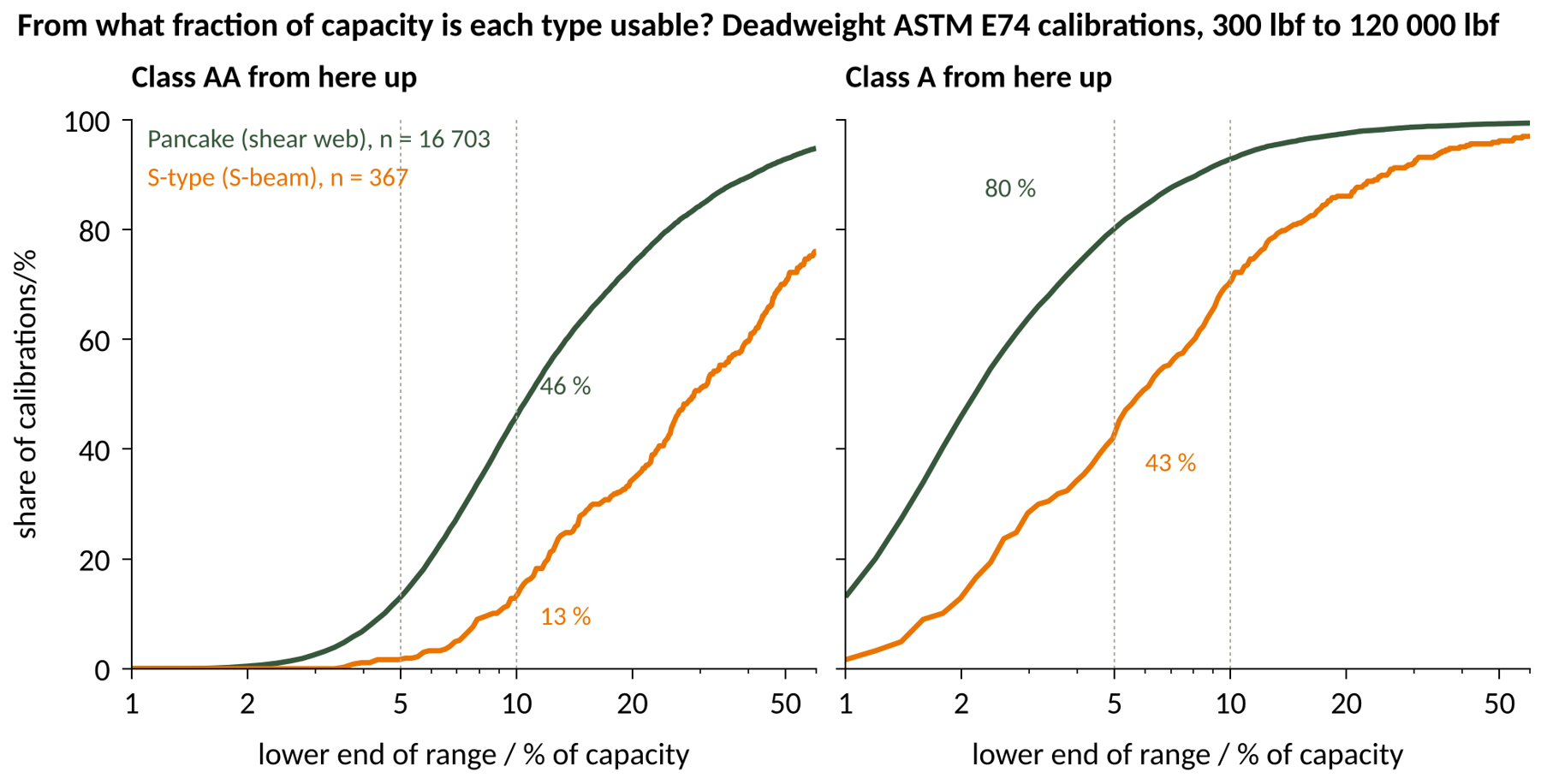
Figure 1. For each lower end of range on the horizontal axis, the share of calibrations whose LLF qualifies the cell for the class from that point upward. Left, Class AA. Right, Class A. Deadweight calibrations only, all indicators.
A buyer does not care about the LLF as such. They care whether the cell can be used at 10 % of capacity, or 5 %, or 2 %, because that decides how many cells they need to cover a range. Figure 1 answers that directly. Read the right-hand panel at 5 % of capacity: 80 % of pancake calibrations are Class A from there up, against 43 % of S-types. At 10 %: 93 % against 71 %. Read the left panel at 10 % for Class AA: 46 % against 13 %.
Put that in purchasing terms. A 10 000 lbf pancake cell is, four times in five, a Class A standard from 500 lbf up. A 10 000 lbf S-type is, three times in five, not. To cover the same range with S-types you buy a second, smaller cell, calibrate it, and keep track of which one is on the frame. The pancake was never the expensive option. It only looked that way on the quote.
Next Year
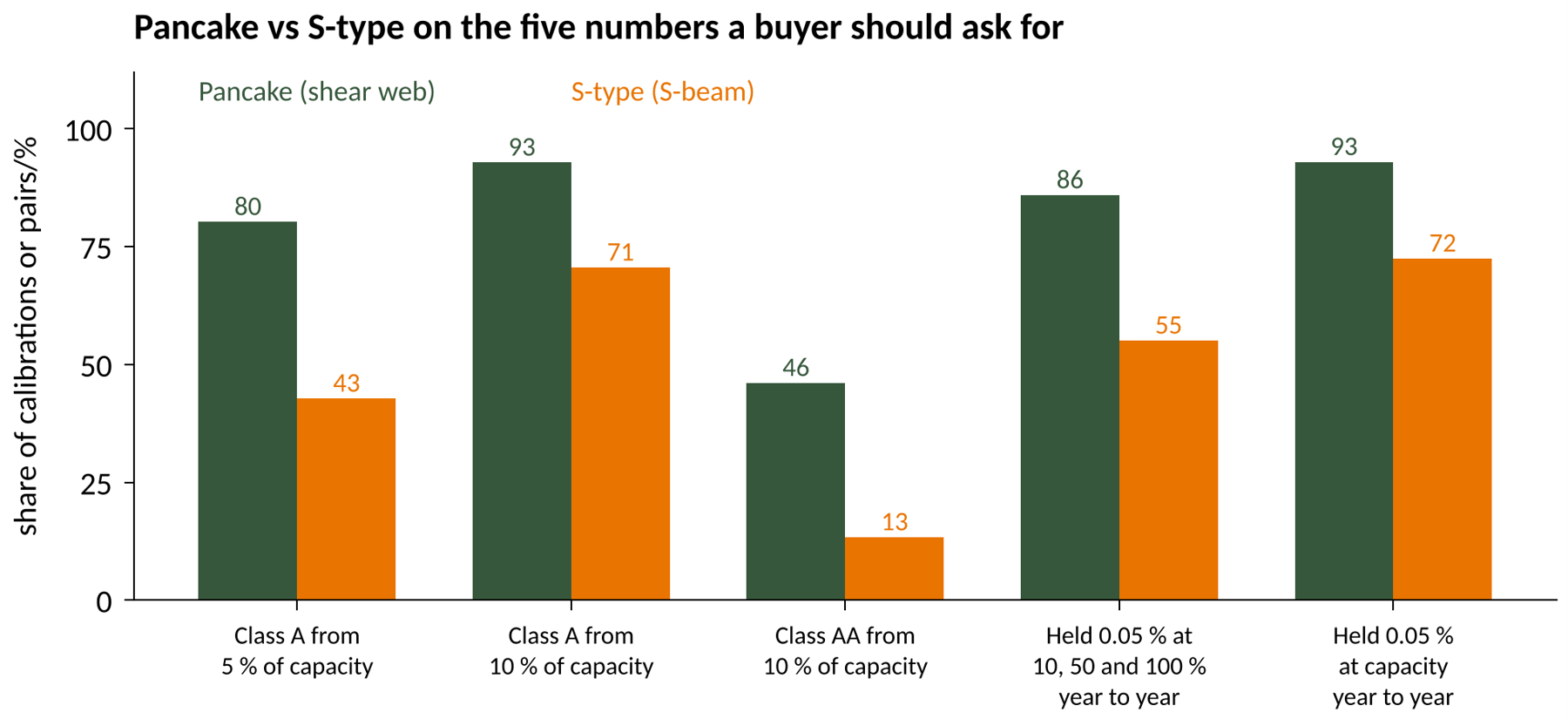
Figure 2. The five numbers side by side. Stability is the share of consecutive calibrations on the same serial number, 200 to 800 days apart, both read on a reference indicator, where the fitted response changed by 0.05 % or less. Pancake: 2 514 pairs. S-type: 69 pairs.
Accuracy on the day is one thing. We also have thousands of cells that came back a year later, so we can say how often each type held what it had. With both calibrations read on a reference-class indicator, pancake cells held 0.05 % at 10 %, 50 % and 100 % of capacity on 86 % of pairs. S-types held it on 55 %. At capacity alone, 93 % against 72 %. Gross changes, a jump of more than 1 % that is almost always a wiring, mounting or damage event rather than drift, hit 0.3 % of pancake pairs and 2.9 % of S-type pairs. The S-type is not drifting more. It is getting mounted, loaded and wired differently every time it comes in, and that is a feature of the shape.
Why the S-Type Loses, and When It Does Not
An S-type cell is loaded through its threads, and the output depends on how it is loaded: through the threads top and bottom, flat on its base with a ball on top, or some mix. On one S-type we measured a difference of 0.369 % of applied force between loading through the threads and loading flat, and even the mildest change in loading condition moved the reading by about 0.03 % [1]. A pancake cell with its integral threaded adapter locked in does not have that problem, because the adapter cannot move and the load path is the same every time. Take the adapter out and a pancake starts to behave like an S-type; we have measured 0.14 % to 0.18 % from thread depth alone [1]. The design advantage is real, but it is the adapter that delivers it.
None of this makes the S-type a bad load cell. It is light, it fits in a tension line where a pancake will not, it survives being used as a crane-scale check weight, and it costs a fraction of a pancake of the same capacity. For a 1 % device, for a weighing application, for a hanging load where you need to see 0.1 %, an S-type is the right answer and the certificate will say so. What the data say is narrower than "S-types are worse." They say: do not buy an S-type to be the reference standard that calibrates other things, and do not believe a datasheet that says its S-type is Class AA from 10 %, because one S-type calibration in eight gets there and the datasheet does not know which one you bought.
Misalignment: The Difference You Cannot See on a Datasheet
There is a second reason the two shapes separate, and it does not show up until the cell leaves the lab. An S-type cell is a bending element. Any force that is not exactly along its axis, from a thread that is not square, a base that is not level, a rough surface that lets the adapter sit a hair off center, adds bending strain that the gauges cannot tell from load. We tested that in the e-book with a 10 000 lbf S-type and a spherical adapter but no alignment plug: less than an eighth of an inch of misalignment produced a 0.752 % error, and the expanded uncertainty of that cell went from about 10 lbf aligned to about 90 lbf misaligned [1]. A rough-finished adapter on another S-type produced an error more than a hundred times what the cell's specification would suggest [1]. None of that is a defect. It is what a bending beam does when you bend it the wrong way.
A pancake cell is built to be insensitive to the same mistakes. Its spokes carry load in shear, they are arranged symmetrically around the axis, and the gauges are wired so that bending from a slightly off-center force shows up as equal and opposite signals that cancel. The result is a cell that is compensated for off-axis loading by its geometry, not by its operator. We have measured off-axis error on a Morehouse shear web cell at 0.0022 % [1], against 0.752 % on the S-type above: the same mistake, three hundred times smaller consequence. That is the part of the comparison the LLF only hints at. Figures 1 and 2 were measured in a machine built to be plumb, level and square, with the right adapters, by technicians who do this all day. Your test frame is not that machine. The pancake forgives the difference. The S-type reports it as force, and the e-book's own recommendation follows from that: an S-type is typically not the right choice when the application needs calibration to ASTM E74, ASTM E4, ISO 376 or ISO 7500 [1].
Three Questions for the Quote
- Which type is it, and is the threaded adapter integral and locked in? If the cell is a reference standard, the answer should be pancake, with the adapter locked in at the factory. Benchmark: median LLF 0.005 % of capacity, Class A from 5 % on 80 % of calibrations.
- From what percent of capacity is the cell Class A, on an ASTM E74 certificate from deadweight? Not from the datasheet, and not from a lab whose own uncertainty is 0.02 %. Benchmark for a pancake: Class A from 5 %; Class AA from 10 % on roughly half of calibrations, so a quote that promises Class AA from 10 % should come with the certificate that proves it.
- Can I see two consecutive certificates on the same serial number? Benchmark: a pancake cell on a reference indicator holds 0.05 % at all three test points on better than 85 % of annual pairs. An S-type holds it on roughly half, and a quote should not pretend otherwise.
The Long Version
The full paper adds column and canister cells, breaks everything out by capacity band, shows the whole LLF distribution rather than the medians, and lists the method so you can run the same analysis on your own E74 data: A buyer's guide to load cell types: shear web vs. column vs. S-beam, from 10 000 calibrations. If you run a lab, pull your data and see whether it tells the same story. Ours took one afternoon and a database query, which is cheaper than the next argument about datasheets.
Reference
[1] Zumbrun, H., Force Calibration for Technicians and Quality Managers: Top Conditions, Methods, and Systems that Impact Force Calibration Results, 4th edition, Morehouse Instrument Company, 2026, pp. 56 to 57 (load cell types and off-axis sensitivity), 204 (surface finish), 213 to 218 (loading conditions and integral adapters) and 239 (misalignment test).
Pancake Load Cell vs S-Type Load Cell Conclusion - About Morehouse
We believe in changing how people think about Force and Torque calibration in everything we do, including, "Pancake Load Cell vs S-Type Load Cell"
This includes setting expectations and challenging the "just calibrate it" mentality by educating our customers on what matters and what may cause significant errors.
We focus on reducing these errors and making our products simple and user-friendly.
This means your instruments will pass calibration more often and produce more precise measurements, giving you the confidence to focus on your business.
Companies around the globe rely on Morehouse for accuracy and speed.
Our measurement uncertainties are 10-50 times lower than the competition, providing you with more accuracy and precision in force measurement.
We turn around your equipment in 7-10 business days so you can return to work quickly and save money.
When you choose Morehouse, you're not just paying for a calibration service or a load cell.
You're investing in peace of mind, knowing your equipment is calibrated accurately and on time.
Through Great People, Great Leaders, and Great Equipment, we empower organizations to make Better Measurements that enhance quality, reduce risk, and drive innovation.
With over a century of experience, we're committed to raising industry standards, fostering collaboration, helping with understanding risk, and delivering exceptional calibration solutions that build a safer, more accurate future.
Contact Morehouse at info@mhforce.com to learn more about our calibration services and load cell products.
Email us if you ever want to chat or have questions about a blog.
We love talking about this stuff. We have many more topics other than, "Pancake Load Cell vs S-Type Load Cell"
Our YouTube channel has videos on various force and torque calibration topics here.