

Tell Me Whose Day Was Better Because You Were in It: Showing Appreciation in the Metrology Community
In December 1989, United States forces cornered Manuel Noriega inside the Vatican embassy in Panama City. The story everyone repeats is the rock playlist. Van Halen’s “Panama.” The Clash. Guns N’ Roses at volume, aimed at the nunciature for ten days until the man walked out. That playlist is real. It was declassified, the press reprints it every few years, and it makes a good headline.
I spent a day in a Vistage session on emotional intelligence with Bob Anderson. Bob was in Panama. He is a combat veteran, a master parachutist, and he speaks Spanish. His account of what actually broke Noriega is not on the declassified list.
It was the Grateful Dead. Specifically, Space.
If you have never sat through it, Space is the stretch in the middle of a Dead show where the band abandons key, meter, and melody. No verse. No chorus. No downbeat. Usually it runs five to seven minutes, still shorter than our 7 to 10 business day lead time. Sometimes twenty. A Dark Star can run longer still. Whatever the length, it is sound that never resolves, and the Grateful Dead is my favorite band.
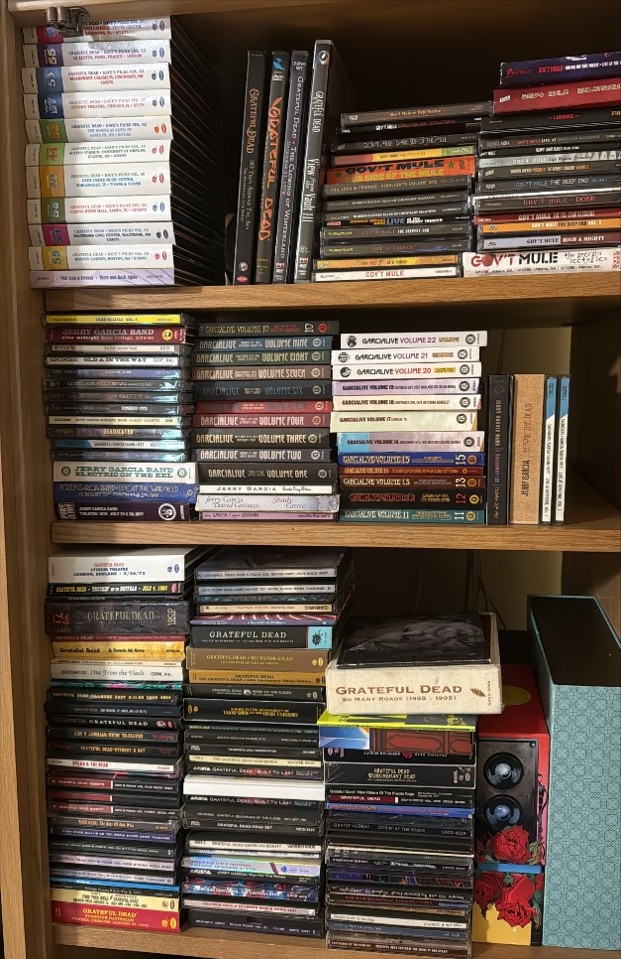
In fact, I might be writing this post just to show off some of my Grateful Dead collection; that is yet to be determined and Bob definitely had my attention when he spoke, and the attention became utmost attention when Grateful Dead was mentioned. There’s some Gov’t Mule in this image as well for anyone that was wondering.
Think about why that is worse than “Welcome to the Jungle” at full volume. Hard rock has a loop. Verse, chorus, verse, and a snare you can count on. Your brain finds the pattern inside an hour, and once it has the pattern it can brace for the next hit. Adaptation is a survival skill, and it works fast. Space hands your brain nothing to find. You cannot predict the next second, so you never stop bracing.
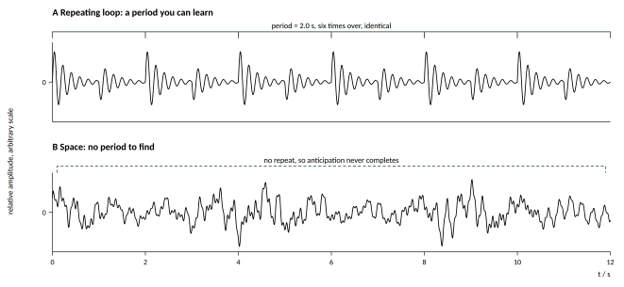
Figure 1. Signal structure, drawn schematically. A repeating loop has a period the listener learns and can anticipate. Space has none, so the anticipation never completes. Not measured data like most of my other posts, though cool sine waves nonetheless.
Environment Influences your Skill
That sentence is in my notes from that day: environment influences your skill.
We hold a force calibration at 23 °C ± 1 °C because we know what temperature does to a load cell’s output; our load cells are typically ± 0.0015 % per °C. Many are much worse than this, so controlling temperature is a shall in both ISO 376 and the ASTM E74 standards. We control the loading rate. We control alignment, because side load shows up in the data whether or not anyone wrote it down. No competent lab accepts an uncontrolled environment and then blames the transducer for the scatter.
Then we walk out of the lab, put people in an emotionally unpredictable environment for 40 hours a week, and blame the people for the scatter.
You are the environment. If your team cannot predict which version of you walks through the door, they spend the day bracing instead of working. That is Space, and you are the band.
Recognition Without the "What" has no Resolution
Bob pushed the room on appreciation, and my note on it is short: make sure you say the what.
Here is why that landed on a metrologist. “Good job” is an unlabeled data point. It carries no information about what to repeat. “I appreciate you” has the same problem. Appreciate what? My Grateful Dead knowledge, my bad jokes, the fact that I showed up? A calibration certificate that reports a value with no uncertainty statement is useless for the same reason: the number is there, the resolution is not. You cannot make a decision with it.
Compare the two. “Nice work on the Baldwin rebuild and calibration” tells someone nothing. “You caught the 0.05 % span shift on the Baldwin before it shipped; we were able to diagnose the cause as a missing top block, and when we got the right top block, it saved the customer a massive recall” tells them exactly which behavior to run again. Same effort. Completely different resolution.
Write it by hand while you are at it. That was the other instruction I took down, and I have started trying to do it, and now I hear Yoda telling me “No. Try not, do, or do not. There is no try.” So, writing this makes me realize I need to be better. I need to be the person that makes someone have a better day.
Optimism Requires Historical Data
This was the line that surprised me most, because it is a measurement statement wearing a leadership hat: optimism requires historical data and what might be next.
Optimism in a laboratory is not a mood. It is a record. When a reference standard has held inside the fitted curve from ASTM E74-18(2026), Standard Practices for Calibration and Verification for Force-Measuring Instruments, for eight years, and the control chart shows no trend, my confidence in tomorrow’s result is not hope. It is extrapolation from data I own, and that is why I think control charts and trend analysis are essential to run a successful measurement system.
Leadership works the same way. A leader who tells the team everything will be fine, with nothing behind it, is guessing out loud. A leader who says “we came through 2020 without a layoff, and here is the backlog that funds this year” is doing trend analysis. Your people can tell the difference immediately, and so can an auditor.
The metrologist’s question is already the right one. What is the chance? We ask it about likelihood and consequences from performing our risk analysis. Ask it about your people with the same rigor you would in a higher risk situation.
Purpose, Process, Payoff
Two types of learning came out of that session. Purpose, which is always know the why; process, which is the how; and payoff, which is the outcome.
Most calibration training delivers the process and skips the purpose. That is how you end up with a technician who applies preload three times because the procedure says three times, and who cannot tell you it exercises the load cell to condition the load cell and seat the loading train. That technician follows the steps until the day the steps do not fit the situation, and then guesses.
The same gap breaks companies. Tell people the why or accept that they will improvise when conditions change.
Three Rungs, and Only One of them Holds
The same session produced a second ladder, and it applies straight to how we sell. Every customer relationship sits on one of three rungs. Only the top one is hard for a competitor to take.
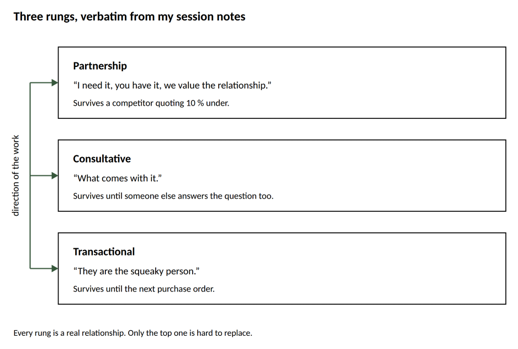
Figure 2. The three rungs, verbatim from my session notes. Work out loud which rung each of your top ten accounts is actually on before you assume it is the top one.
The Line I Keep Coming Back To
At the top of my notes I wrote: there is so much more I want to be. Near the bottom I wrote something harder. I was wrong. You all deserve better. I can be better.
I am CEO of a company founded in 1920 by William S. Morehouse, whom my great-grandfather worked for as a master machinist. My assessment came back with interpersonal relationships ranked first among the skills I most want to build, and my self-regard scored the lowest number on the page. I get down on myself, and I can be a pessimistic A-hole about pace: everything moves too slowly, we are not good enough, never mind that our growth through improvement and education has been phenomenal. I joke that the calibration and the product could both be perfect and I would still be dissecting the non-value-added steps. I do wish I could turn that part of me off at times. Read that combination honestly. The thing I care most about getting right is the thing I have the least confidence in. Publishing that is uncomfortable, which is a decent sign it is worth publishing for anyone that’s still with me in this post, at least.
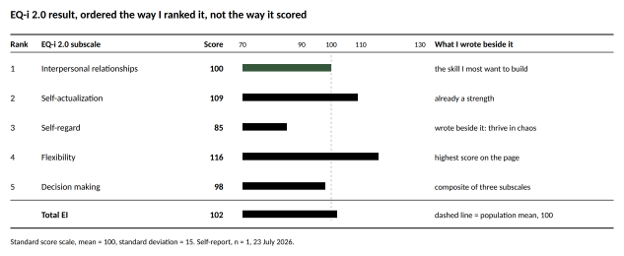
Figure 3. My own EQ-i 2.0 result, ordered by the priority I assigned each skill in the session rather than by score. The number I care most about improving is not the lowest number on the page.
The practical takeaways from that room are small enough that nobody has an excuse. Say the what when you recognize someone. Write the note by hand. Turn a complaint into a request. Answer with “yes, and” instead of “no, but.” A little effort goes a long way, and if we put in the effort, the people around us are better for it.
Bob closed with a challenge that has not left me alone since.
Tell Me Whose Day Was Better Because You Were in It.
You cannot answer that one from a dashboard. There is no coverage factor on it, no decision rule, no guard band. You either made someone’s day better or you did not, and the only person who can score it is the person who spent the day with you.
Go ask one of them this week. Then decide whether the people around you are hearing a song or hearing Space. And if you have never sat through Drums into Space, go listen once. You will get the metaphor faster than I can explain it. Because if they have been bracing all year, they may already be looking for a place where the next note is predictable. Dramatic? Maybe. It is also how good people quit. For you Canadians, don’t be a hoser 😊. Bob and Doug McKenzie will be saved for another post.
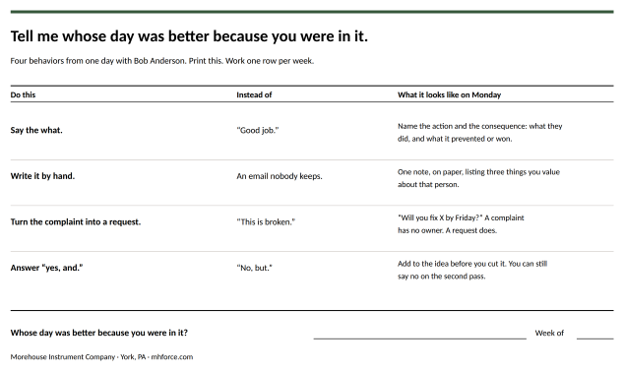
Figure 4. Print this one and keep it where you will see it. Four behaviors, each replacing something most of us already do.
-Henry Zumbrun, Morehouse Instrument Company
Sources and Notes
The Grateful Dead detail in this piece comes from Bob Anderson directly. It does not appear on the declassified United States Southern Command loudspeaker playlist, which lists hard rock and pop. Treat the playlist as the documented record and Bob’s account as first-hand testimony from a soldier who was there. Both can be true.
- United States Southern Command, loudspeaker playlist, Panama, December 1989 to January 1990. Reproduced by the National Security Archive, George Washington University.
- United States Army, “Operation Just Cause: Noriega Surrenders,” army.mil, article 253046.
- Robert G. Anderson, MEd, CEO and co-founder, 1Hero Sports LLC and Leading Challenges LLC. Vistage session, Harnessing the Power of Emotionally Intelligent Leadership, 2026. Handwritten session notes on file.
- Multi-Health Systems Inc., EQ-i 2.0 Workplace Report, Leadership Development Report for Henry Zumbrun, 23 July 2026. Standard score scale, mean = 100, standard deviation = 15.
- Gallup Q12 employee engagement items, as used in the session handout.
- ASTM International, ASTM E74-18(2026), Standard Practices for Calibration and Verification for Force-Measuring Instruments, West Conshohocken, PA, 2018.
- Thompson and B. N. Taylor, Guide for the Use of the International System of Units (SI), NIST Special Publication 811, 2008 Edition. Unit expression in this document follows SP 811.
About Morehouse
We believe in changing how people think about Force and Torque calibration in everything we do, including, "Tell Me Whose Day Was Better Because You Were in It: Showing Appreciation in the Metrology Community"
This includes setting expectations and challenging the "just calibrate it" mentality by educating our customers on what matters and what may cause significant errors.
We focus on reducing these errors and making our products simple and user-friendly.
This means your instruments will pass calibration more often and produce more precise measurements, giving you the confidence to focus on your business.
Companies around the globe rely on Morehouse for accuracy and speed.
Our measurement uncertainties are 10-50 times lower than the competition, providing you with more accuracy and precision in force measurement.
We turn around your equipment in 7-10 business days so you can return to work quickly and save money.
When you choose Morehouse, you're not just paying for a calibration service or a load cell.
You're investing in peace of mind, knowing your equipment is calibrated accurately and on time.
Through Great People, Great Leaders, and Great Equipment, we empower organizations to make Better Measurements that enhance quality, reduce risk, and drive innovation.
With over a century of experience, we're committed to raising industry standards, fostering collaboration, helping with understanding risk, and delivering exceptional calibration solutions that build a safer, more accurate future.
Contact Morehouse at info@mhforce.com to learn more about our calibration services and load cell products.
Email us if you ever want to chat or have questions about a blog.
We love talking about this stuff. We have many more topics other than, "Tell Me Whose Day Was Better Because You Were in It: Showing Appreciation in the Metrology Community"
Our YouTube channel has videos on various force and torque calibration topics here.