

What a Recovering Drug Addict Taught me about Saying No: When Metrology Companies Should Say No
I went to a Vistage seminar for the inspiration on learning a better way to say “no”.
By Henry Zumbrun, CEO, Morehouse Instrument Company
Michael Brody-Waite stood in front of a room full of CEOs at my Vistage meeting and told us the smartest thing we could do for our companies was to live like recovering drug addicts. He has earned the right to say it. He was a full-blown addict by twenty-three, homeless and certain he would be dead by thirty, and he got sober, built a career as an entrepreneur and CEO, and gave the TEDx Nashville talk “Great Leaders Do What Drug Addicts Do,” which has now been watched more than a million times. His book is Great Leaders Live Like Drug Addicts. The premise is simple. The three disciplines that keep an addict alive are the same three that make a leader effective: practice rigorous authenticity, surrender the outcome, and do uncomfortable work.
I run a calibration company. I spend my working life separating what a measurement feels like from what it actually is. So, when Brody-Waite took a leadership decision and turned it into that same separation, he had my full attention.
Here is the part nobody tells you about a good seminar. The inspiration is the easy part. I have sat through plenty of talks that moved me and when I spoke with my team the next day, the passion was not being absorbed by the team, it was more like “can you be clear, we have no idea what you are wanting us to do?”, and when I tried to explain or implement, the friction was too high, kind of like wanting to work out after eating a big meal, the effort to move, change clothes, and get your butt in gear, is much higher than after eating a light salad and having gone for a walk in comfortable clothes afterward.
This session one came with a workbook, and the workbook made me do the uncomfortable thing: pick a real decision I had been avoiding and run it through six steps. Inspiration is not the deliverable. Implementation is.
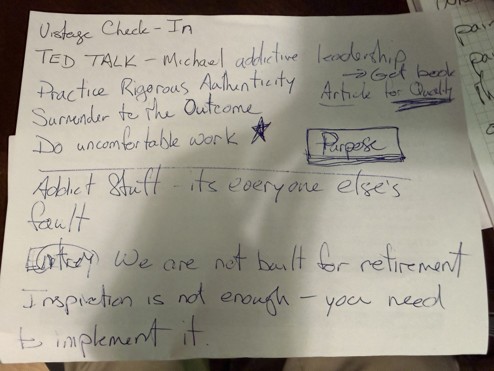
My check-in notes from the session. The last line is the one that stuck: inspiration is not enough, you have to implement it.
So let me show you the decision I ran, and where it landed.
Step one is What: name the behavior. Mine was easy to find and embarrassing to admit. I keep saying yes to big-ticket customers. The large opportunity that walks in the door with a flag on it.
Step two is Who. Customers, and specifically the big ones. The yes does not stop at me, though. It pulls in executive leadership, sales, and engineering every time.
Step three is Cost, and this is where a feeling becomes a figure. Brody-Waite’s point is that numbers are the one language every business actually shares, and he is right. Call it one hour a week chasing or accommodating a big-ticket request that turns out to be low value. One hour across fifty working weeks is fifty hours a year. Fifty hours I am handing to the likely wrong yes.
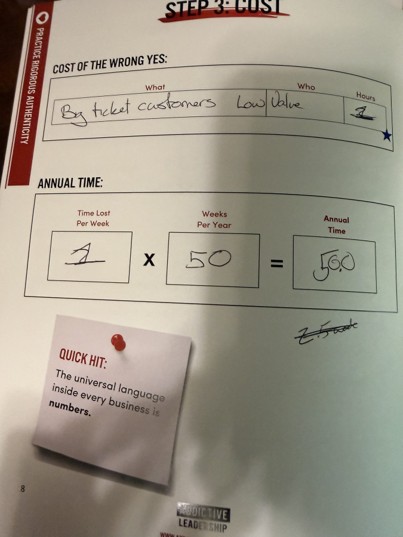
Step 3, Cost. One hour a week × fifty weeks = fifty hours a year going to the wrong yes.
Step four is the High-Value Activity, the HVA, the right yes those fifty hours could buy instead. For me, that is coaching and training my team. The benefit is efficiency. The number I would watch to know it is working is revenue. What if those fifty hours went somewhere that compounds, into people who get a little better every week, instead of into a one-off that ends the day it ends?
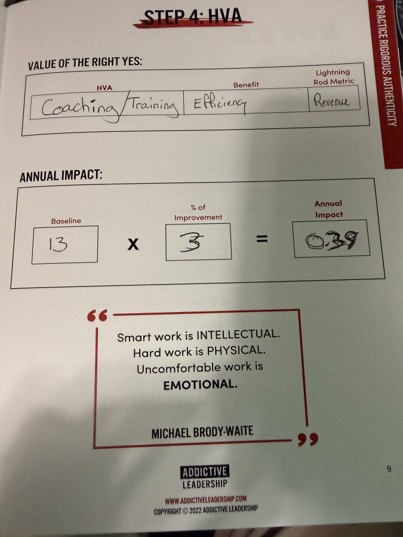
Step 4, the high-value activity: coaching and training, with revenue as the metric that proves it worked.
Step five is Fear, and this is the step that stopped me cold.
If saying no was obviously the right call, why had I not already said it?
So, I wrote the fear down. What would the customer think? That we did not want to work with them, that we could not solve their problem. What could happen to me? Get bad-mouthed, lose reputation. What was the full death-or-doom version of the story? Lose the business, get bad-mouthed badly enough that they leave and take other customers with them, and the lost revenue forces layoffs, and now some of our great people have to find jobs elsewhere.
Then Brody-Waite makes you do arithmetic on your own fear. Rate how that doom feels on a scale of one to ten. I put a nine. Rate how probable it actually is on the same scale. Honestly, a one. Divide the feeling by the probability and multiply by a hundred.
(9 ÷ 1) × 100 = 900
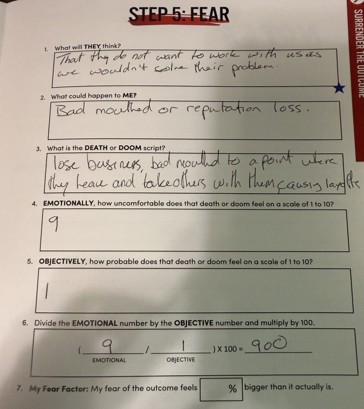
Step 5, Fear. Emotional 9, objective 1. The fear measured 900 % bigger than the risk it was protecting me from.
My fear of the outcome was 900 % bigger than the outcome itself. Say what now?
Here is why that number landed the way it did for me. In the lab, we would never accept a pass or fail based on how risky a result feels. We separate the measured value from the guard band, and we decide against a documented rule, because the feeling and the measurement are not the same thing, and the gap between them is exactly where bad decisions live. Brody-Waite’s Fear Factor is the same move, pointed at a leadership decision. It put a guard band on my emotions.
He has a line for why this happens: “Smart work is intellectual. Hard work is physical. Uncomfortable work is emotional.” The no had not sat undone because it was difficult. It sat undone because it was emotional, and emotional is the kind of work most of us are quietest about avoiding.
Step six is Action: a plan with a date. Say no to the low-value big-ticket request a set number of times by a deadline, so the time actually moves to the high-value activity instead of evaporating. A no without a date is a wish.
One more idea from the seminar has stuck with me. The change does not come from the list of things you stop. It comes from the things you start. The point of saying no to fifty hours of the wrong work is not the subtraction. It is what you get to add.
Now scale that one decision up to the whole company. A single no is a discipline. A company that knows which noes to say has a strategy. In the lab, we already trust the rule over the gut. We do not pass or fail a load cell on instinct. We compare the result against a documented decision rule and a guard band, every time. So why run the business with less rigor than we run a calibration? What is the documented rule that decides which customer, which project, which big-ticket flag earns a yes?
Jim Collins named that rule in Good to Great. He calls it the Hedgehog Concept, the intersection of three questions: what are you deeply passionate about, what can you be the best in the world at, and what drives your economic engine? Once you have answered all three, every decision in the company is supposed to follow it, and anything that does not fit the Hedgehog Concept is not considered. That last line is the whole game. The Hedgehog turns no from a feeling into a rule. It is a guard band for the business.
Ours translates straight into metrology. Rename the Hedgehog measurement confidence. We are passionate about a safer world through better force and torque measurement, we can be the best in the world at the lowest measurement uncertainty, and our engine runs on customers who need that confidence. A big-ticket request that sits outside those three circles is not an opportunity. It is fifty hours leaking out of the work that compounds.
Saying yes outside the circles costs more than the calendar. Henry Petroski's To Engineer is Human is a catalog of what happens when capable people accept work they should have refused: a doubled force on a single nut at the Hyatt Regency, 114 dead; a wrong adapter, copied from a design that worked once somewhere else, producing significant measurement errors on the next job. Saying yes to work outside your competence is not generosity to the customer.
It is how the world becomes less safe. James Clear closes the loop in Atomic Habits: you do not rise to the level of your goals, you fall to the level of your systems. The Hedgehog is the system. The fear factor is the daily habit that keeps you honest with it. Move fifty hours off the wrong yes and into a technician who gets one percent better each week, and the arithmetic stops being subtraction. One percent better across 225 working days is 1.01^225, roughly 9.38 times sharper than where that person started.
Want to fill out your own action card? Here’s a link courtesy of Michael.
So if you download the action card, I would ask you to do.. Pick the one yes you have been avoiding saying no to. Put a cost on it in hours or dollars. Write down the doom story, rate how it feels, rate how likely it is, and calculate your own fear factor. I suspect the gap will surprise you the way mine surprised me. Then watch the TEDx talk, and if it lands, read Great Leaders Live Like Drug Addicts. The inspiration is free. The implementation is the part worth doing.
–Henry Zumbrun, Morehouse Instrument Company
About Morehouse
We believe in changing how people think about Force and Torque calibration in everything we do, including, "What a Recovering Drug Addict Taught me about Saying No: When Metrology Companies Should Say No"
This includes setting expectations and challenging the "just calibrate it" mentality by educating our customers on what matters and what may cause significant errors.
We focus on reducing these errors and making our products simple and user-friendly.
This means your instruments will pass calibration more often and produce more precise measurements, giving you the confidence to focus on your business.
Companies around the globe rely on Morehouse for accuracy and speed.
Our measurement uncertainties are 10-50 times lower than the competition, providing you with more accuracy and precision in force measurement.
We turn around your equipment in 7-10 business days so you can return to work quickly and save money.
When you choose Morehouse, you're not just paying for a calibration service or a load cell.
You're investing in peace of mind, knowing your equipment is calibrated accurately and on time.
Through Great People, Great Leaders, and Great Equipment, we empower organizations to make Better Measurements that enhance quality, reduce risk, and drive innovation.
With over a century of experience, we're committed to raising industry standards, fostering collaboration, helping with understanding risk, and delivering exceptional calibration solutions that build a safer, more accurate future.
Contact Morehouse at info@mhforce.com to learn more about our calibration services and load cell products.
Email us if you ever want to chat or have questions about a blog.
We love talking about this stuff. We have many more topics other than, "What a Recovering Drug Addict Taught me about Saying No: When Metrology Companies Should Say No"
Our YouTube channel has videos on various force and torque calibration topics here.