
Key Capabilities for Healthcare Applications
Compact and Low-Capacity Load Cells for Medical Devices
Many healthcare instruments apply relatively small forces—e.g., dynamometers, implant testing, ergonomic force gauges. Morehouse designs compact, high-accuracy load cells optimized for these applications and widely used as Force Sensors for Healthcare.
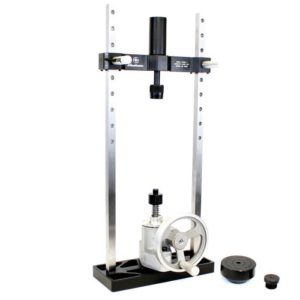
For example, their “Portable Force Calibrating Machine” supports devices with resolutions as low as 0.005 lbf in tension/compression.
These compact designs allow integration into medical device test rigs, fit within small bench spaces, and maintain measurement integrity in sensitive healthcare labs.
Calibration of Force Gauges, Handheld Instruments, and Rehabilitation Equipment
Healthcare providers and manufacturers rely on accurate force gauges and patient-interface sensors—e.g., handheld muscle-strength dynamometers and patient load cells in rehab machines. These devices essentially function as Force Sensors for Healthcare, where accuracy directly affects patient evaluations and treatment decisions. Morehouse explicitly references these tools in their healthcare materials: “Imagine a scenario … a muscle strength test … the precision of this device must be balanced.”
Morehouse provides calibration services that:
-
Verify both tension and compression modes
-
Use proper adapters to match device geometry
-
Document measurement uncertainty for patient safety and regulatory compliance
Deadweight and Primary Standard Calibrations for Ultra-Low Uncertainty
Although many healthcare forces are small, some critical devices require ultra-low measurement uncertainty—such as load stands for MRI patient tables, robotic surgery arms, or force sensors in life-support equipment.
These systems rely on extremely accurate Force Sensors for Healthcare, and Morehouse’s deadweight machines deliver uncertainties as low as 0.002% of applied force.
These capabilities translate into high confidence when verifying precision devices in healthcare settings.
Custom Load Cell Systems for Large-Scale Medical Equipment and Weighing
While many healthcare applications are small-scale, some require robust, large-capacity force or weight sensing—for example:
-
Patient lifts
-
Hospital bed load sensors
-
Lift and transfer equipment
-
Surgical table load balancing
Morehouse’s custom load-cell and calibration solutions—applied across multiple industries—can be adapted to create application-specific Force Sensors for Healthcare, ensuring traceable accuracy across the full range of forces.
System-Level Calibration Matching Real-Use Conditions
Healthcare devices often operate under unique, non-ideal conditions: multiple attachments, variable patient-interface geometries, multi-axis loading, ergonomic offsets, and dynamic forces (e.g., patient movement).
Laboratory-only calibration doesn’t always reflect real use.
Because of this, Morehouse emphasizes calibrating the entire system—sensor + fixture + adapter—when working with Force Sensors for Healthcare, modeling measurement uncertainty to match real-world behavior.
This ensures calibration results remain meaningful in operational settings, reducing measurement risk and improving patient-care outcomes.
Why Healthcare Teams Choose Morehouse
-
Compact, low-capacity load cells for sensitive medical devices and other Force Sensors for Healthcare
-
Calibration services for handheld force gauges, patient-interface sensors, and rehabilitation equipment
-
Deadweight/primary standard calibrations for ultra-low uncertainty when critical healthcare devices require the highest accuracy
-
Custom load-cell solutions for larger medical equipment weighing and high-force healthcare tasks
-
System-level calibration and traceable uncertainty modeling that reflect real healthcare use-cases
-
ISO/IEC 17025 accredited services, traceable to SI through an NMI such as NIST
In effect, the same calibration-first principles used in aerospace, oil & gas, and nuclear sectors apply here—adapted to the unique needs of Force Sensors for Healthcare, where devices span small to large-force ranges and patient safety and regulatory oversight are paramount.
Morehouse provides healthcare-grade, calibration-first accuracy for applications ranging from hand-held muscle strength gauges to large-scale patient-equipment weighing systems.
By combining compact load cells, low-uncertainty deadweight calibration, system-level calibration protocols, and custom design support, Morehouse ensures your Force Sensors for Healthcare deliver reliable, traceable, and patient-safe measurements.
If you want to learn how Morehouse can help you improve your Force Sensors for Healthcare applications and achieve more reliable measurements, contact our Sales team.
For additional training materials—including webinars on measurement risk, calibration best practices, and using Force Sensors for Healthcare—visit our YouTube channel:
https://www.youtube.com/@mhforcecalibration