
Calibration-First Accuracy for Oil & Gas Testing, Production, and Certification
In upstream oil and gas operations, oil and gas force measurement accuracy is essential to maintaining process integrity across applications such as well stimulation, hydraulic fracturing, cementing, mud pumping, and coiled tubing.
Morehouse supports these operations with custom-calibrated systems that verify hook load, rotary table torque, and standpipe pressure under dynamic field conditions.
Our solutions ensure stable, traceable force data for acidizing, wireline, slickline, and well logging services — where vibration, pressure fluctuations, and eccentric loading can introduce measurement bias.
For nitrogen pumping, choke manifold calibration, directional drilling, and sucker rod tension, Morehouse load cells deliver repeatable, reliable measurements supported by applied measurement uncertainty (MU) modeling.
All calibrations conform to API and ISO/IEC 17025 standards and replicate real-world loading to minimize bias and improve field correlation.
These calibration methods simulate actual operating conditions to reduce uncertainty and ensure confidence from the calibration lab to the production site.
Midstream and Refining Operations
In midstream and refining operations, oil and gas force measurement accuracy is equally critical for maintaining pipeline integrity, pressure balance, and equipment reliability.
Accurate force and torque calibration ensures valve integrity, prevents flange leakage, and maintains system balance under continuous load and vibration.
Morehouse provides system-level calibration for pipeline compression, valve actuation, pig launcher and receiver systems, and storage tank load monitoring.
Our calibration procedures simulate operating pressures and temperatures to validate sensor performance under API 1104, ASME B31.3, and IECEx standards.
Within refineries, Morehouse load cells and torque transducers are used to validate heat exchanger bolt tension, flange torque, reactor clamp loads, and lifting or hoisting systems during maintenance and turnaround events.
Each calibration includes traceable uncertainty analysis to quantify total system error — including fixture stiffness, temperature variation, and adapter eccentricity.
Hazardous and Classified Oil and Gas Force Measurement Environments
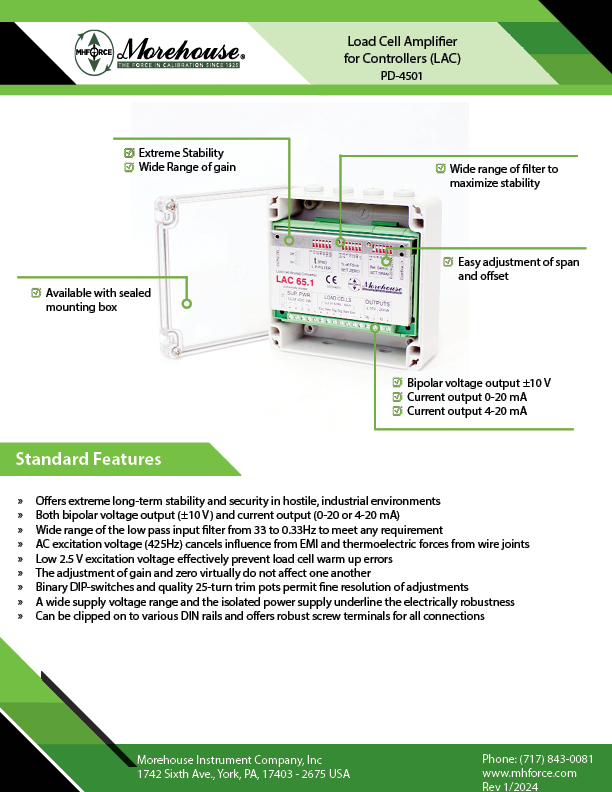
For hazardous and classified oil and gas force measurement environments, Morehouse integrates ATEX- or IECEx-approved amplifiers (II 1 G Ex ia) and pressure-compensated load cells designed for safe operation in Class I, Division 1 and Division 2 zones.
These solutions enable reliable, repeatable oil and gas force measurement and torque measurements across the refining, transmission, and storage segments of oil and gas operations — ensuring compliance, safety, and audit readiness.
Why Oil & Gas Teams Choose Calibration-First Mentality
- Drilling and Production: Reliable load data for top drive torque, riser tensioning, and mooring line systems with system-level uncertainty that includes fixtures and adapters.
- Pipeline and Refinery Operations: Force calibration solutions engineered for high pressure and temperature environments, helping prevent leaks and structural failure.
- Instrumentation & Monitoring: Mixed-brand sensor stacks verified and normalized for consistency in hazardous areas (Class I Div 1 and Div 2).
- Maintenance and Inspection: Guardband-ready MU certificates ensure traceability and compliance with API, ATEX, and IECEx standards.
- Quality & Safety Compliance: ISO/IEC 17025-accredited and traceable to SI through NIST; designed to meet or exceed industry codes and specifications.
- Engineering & R&D: Predictable calibration windows reduce downtime, improve reliability, and enable faster, data-driven decision-making.
When to Bring Morehouse In
- You need confidence in measurement systems operating in explosive or high-pressure environments.
- Equipment readings don’t correlate after sensor or amplifier changes.
- Audit findings cite unclear traceability or missing uncertainty data.
- Your safety-critical testing must meet API or IEC compliance with traceable calibration records.
- You’re modifying standard load cells for unique setups that demand custom geometry.
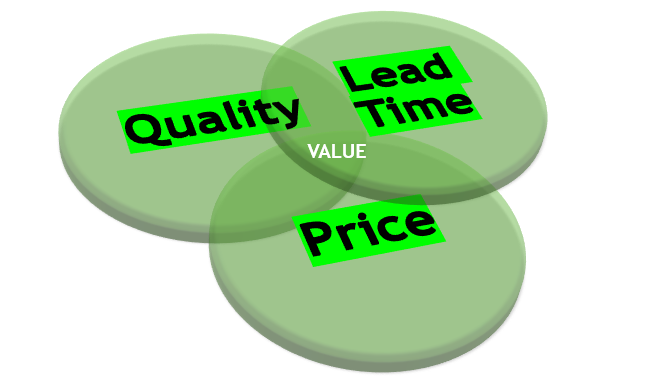
- Your current vendor cannot provide acceptable delivery or turnaround times.
- If your vendor specifies only “NIST traceable” calibration — this often means they are not accredited to perform calibrations per ISO/IEC 17025 requirements.
Custom Load Cells for Oil & Gas Applications
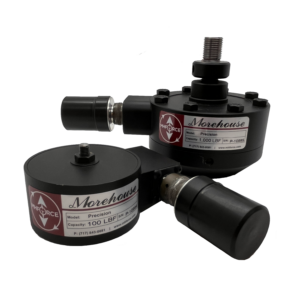
Morehouse designs and manufactures custom load cells built to thrive in the demanding conditions of oil and gas environments, supporting reliable oil and gas force measurement where precision and durability are critical.
When standard load cells can’t achieve the required geometry, corrosion resistance, or sealing performance, our custom-engineered solutions deliver performance without compromise.
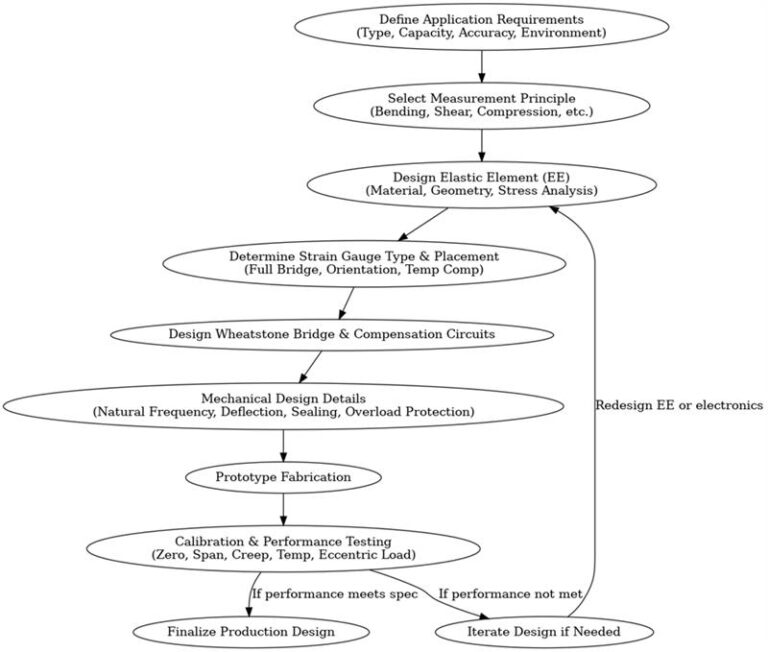
Each load cell is modeled, machined, and calibrated in-house, ensuring predictable behavior under compression, tension, and torsional loading.
These designs minimize setup time, eliminate adapters, and reduce potential error sources — providing accurate, repeatable, and traceable data essential for oil and gas force measurement in even the harshest offshore or refinery conditions.
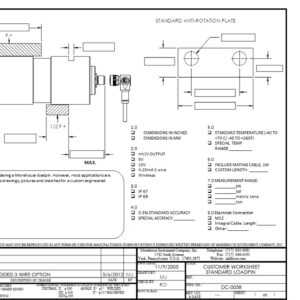
We collaborate directly with engineering teams to ensure full mechanical and electrical compatibility. STEP files and control drawings are provided for CAD approval, with configurable thread sizes, body lengths, and connector orientations.
Safety and Environmental Adaptability
Morehouse understands that oil and gas force measurement often occurs in hazardous or classified environments.
We can integrate ATEX-approved amplifiers (II 1 G Ex ia) and design for NFPA 70 / NEC 501 Class I, Division 2 compliance to prevent ignition risks while maintaining calibration stability.
Our materials and construction techniques are selected to resist corrosion, maintain sealing integrity, and prevent heat buildup in explosive or high-pressure conditions — ensuring oil and gas force measurement remains safe, stable, and reliable.
Material and Performance Assurance
Material selection is vital for durability, accuracy, and safety.
Morehouse engineers balance tensile strength, corrosion resistance, and impact toughness to meet strict oil and gas safety factors.
We evaluate stress corrosion cracking (SCC) resistance, impact strength at low temperatures, and other parameters to ensure consistent performance from the Gulf Coast to Arctic environments.
Typical calibration performance targets — such as a 0.5 % full-scale error band — are validated through system-level testing that mirrors true field conditions.
For example, 17-4PH or 440C stainless steel may be selected based on strength, weldability, and sealing requirements for subsea or topside installations.
Advanced Measurement Capability
For complex oilfield and energy applications, Morehouse engineers design bi-axial, tri-axial, and custom load systems capable of measuring forces up to 2,250,000 lbf on a single axis — delivering the stability required for oil and gas force measurement at extreme capacities.
In high-capacity systems, operators often use three to four load cells with capacities ranging from 1,000,000 to 1,500,000 lbf, working in tandem to measure loads of up to 6,000,000 lbf, all with system-level calibration and traceable uncertainty.
These assemblies maintain cross-axis integrity, deliver high repeatability, and are sealed to resist corrosion or fluid ingress — ensuring dependable oil and gas force measurement in harsh environments.
Custom configurations can include sensor port orientation, MS connectors, and pressure-rated housings to integrate seamlessly with your systems.
Applied Measurement Uncertainty (MU)
A load cell that performs at 0.25 % error in the lab may exhibit 2–3× greater uncertainty in the field due to vibration, misalignment, or environmental effects — a common challenge in oil and gas force measurement.
Morehouse develops applied MU models specific to your conditions, allowing your engineers to quantify and manage uncertainty across the entire measurement chain.
We also replicate your system configurations to ensure calibration setups accurately reflect how your equipment is used in the field, improving correlation and confidence in oil and gas force measurement performance.
What You Get
- System-Level Calibration replicating real-world conditions.
- Applied Measurement Uncertainty (MU) and decision rules for guardbanding or stated accuracy.
- ISO/IEC 17025 Certificates, traceable to SI through NIST.
- Load Cell Modeling and Analysis by our engineering team.
- STEP Files and Control Drawings for CAD verification.
- Direct Collaboration with Morehouse engineers to ensure technical compliance and system fit.
Examples of Load Cells Available
- Pressure-Compensated Load Cells
- Wireline Load Cells
- Mooring System Load Cells
- Custom Torque Load Cells
- Custom Load Pins
- Shackle Load Pins
- Wireless ATEX Accessories
- Standard Shear Web Load Cells
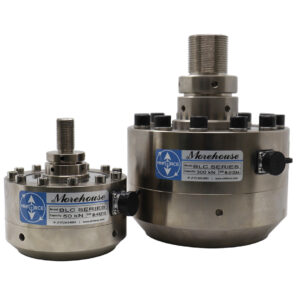
- Large-Capacity Multicolumn and Single-Column Load Cells
- And many others available upon request
Oil and Gas Force Measurement Summary
Morehouse delivers calibration-first accuracy for oil and gas operations — from refineries to offshore rigs.
We combine system-level calibration with custom engineering, environmental safety compliance, and materials expertise to ensure your force and torque data is traceable, defensible, and field-ready.
With fast turnaround and ISO/IEC 17025-accredited processes, Morehouse helps oil and gas teams achieve confidence in every measurement — supporting safer, more efficient operations worldwide.
Ready to increase reliability and safety in your oil and gas testing?
Our engineers can help design, calibrate, and certify systems that meet the world’s toughest industry standards.
Let’s discuss your next project —Contact Sales
For more information or webinars on measurement risk and oil and gas force measurement, please visit our YouTube channel: https://www.youtube.com/@mhforcecalibration