
Calibration-First Accuracy for Aerospace Testing
Aerospace force measurement leaves little room for assumption. One small misstep in calibration can ripple through an entire campaign.
Morehouse starts with a calibration-first mindset — verifying every sensor, indicator, and fixture as one system. We provide audit-ready documentation, traceable measurement uncertainty, and the kind of repeatability that stands up to inspection.
Field performance rarely matches lab conditions, so we model real-world variables like fixture alignment, off-axis loading, and temperature drift. That data gives engineers a clear picture of how their load cells will behave when the test article is hot, vibrating, or under stress.
Why Aerospace Teams Choose Morehouse
- Propulsion Testing — Consistent thrust correlation across test runs, supported by one unified uncertainty figure for the complete measurement chain.
- Structural & Loads — Fixtures and adapters built to align perfectly with load paths, eliminating setup-induced error before testing begins.
- Instrumentation & DAQ — Mixed-brand hardware verified and normalized so data stays clean from ignition to cutoff.
- Manufacturing & Acceptance — Guardband-ready uncertainty on every certificate to keep audits smooth and prevent rework.
- Quality & Compliance — Accredited to ISO/IEC 17025 and traceable through NIST, with load cells machined to meet aerospace-grade specifications.
- Operations & R&D — Predictable calibration intervals that cut down scrubs and shorten iteration cycles.
When to Bring Morehouse In
- Your team needs reliable aerospace force measurements before certification testing begins
- Thrust or structural data won’t line up after changing sensors or indicators
- Auditors ask for traceability you can’t easily demonstrate
- Deadlines are tight and confidence in your data has to be immediate
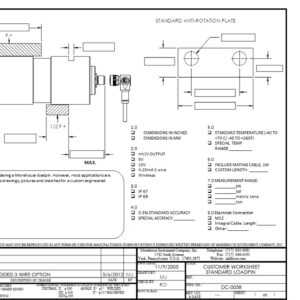
- A custom load cell could solve fit and accuracy problems faster than modifying a standard unit
Custom Load Cells for Aerospace Force Measurement Applications
Every test setup has its quirks. Standard load cells often don’t fit, or they distort load paths that were carefully designed.
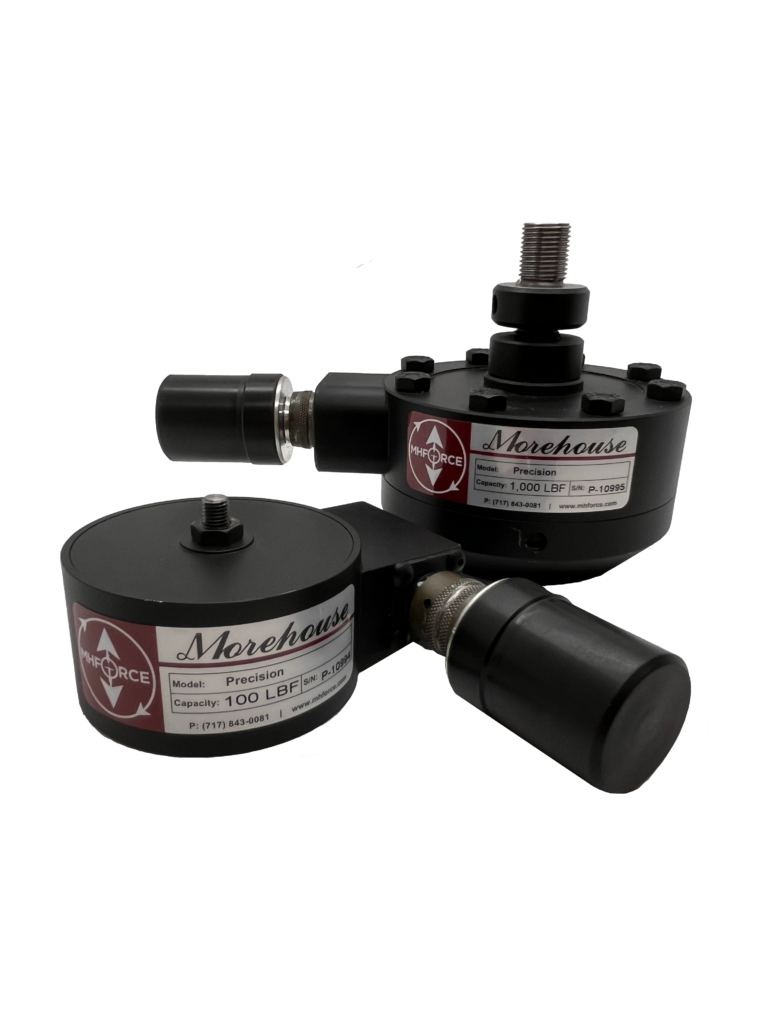
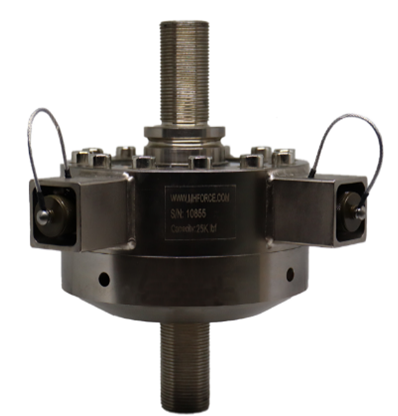
Morehouse builds custom load cells to match your exact geometry and performance needs, ensuring the precision required in aerospace force measurement. Each unit is modeled, machined, and calibrated in-house so it performs predictably under combined loading.
This approach reduces adapters, minimizes alignment issues, and removes unnecessary guesswork. We also provide STEP files and control drawings for CAD review, giving your team confidence in clearances before machining begins.
It’s the kind of collaboration that keeps tests moving forward instead of sideways.
Safety and Environmental Adaptability
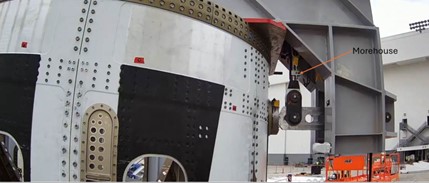
Aerospace force measurement work isn’t gentle on equipment. Test environments can be hot, cold, explosive, or all three at once.
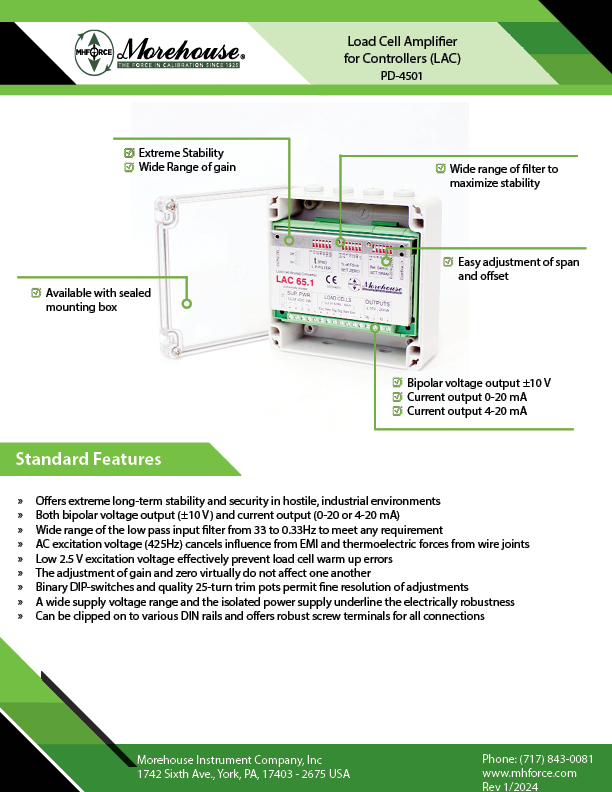
Morehouse systems are designed for that reality. We use ATEX-approved amplifiers (II 1 G Ex ia) and can meet NFPA 70 / NEC 501 Class 1 Div 2 standards when required.
Materials and layouts are chosen to shed heat, resist ignition risk, and stay stable under vibration. The result is a calibration system that keeps its accuracy in conditions that would destroy most lab gear.
Material and Performance Assurance
The choice of material shapes everything — reliability, fatigue life, even the way a sensor reacts to temperature swings.
We evaluate each alloy for stress corrosion cracking, low-temperature toughness, and long-term stability before a design ever hits production, ensuring it meets the demands of aerospace force measurement.
Typical calibration targets hover around half a percent of full scale, but we validate them through full-system testing that mirrors real aerospace loading.
Every alloy brings trade-offs. Take 440C stainless: incredibly strong, but less forgiving when it comes to welding or sealing. We help customers weigh those factors so the final design hits the right balance of strength, manufacturability, and safety margin.
Application Examples
- Transducers built for vibration, vacuum, and cryogenic testing
- High-accuracy load cells used for lifting and component positioning
- Multi-axis setups for center-of-gravity measurement
- Load sensors for control-system input monitoring
- Non-magnetic configurations for use near guidance or scientific instruments
- Hydrogen-compatible and pressure-compensated designs for corrosive or high-pressure systems
Advanced Multi-Axis Capability
Some tests pull in multiple directions at once — literally.
Morehouse has built bi-axial and multi-axis load pins that measure up to 200,000 lbf per axis while keeping cross-axis interference minimal, delivering the reliability required for precise aerospace force measurement.
We can include military-spec connectors and custom sensor orientations to match your test stand’s wiring and space limits.
Those options make complex testing cleaner, faster, and far easier to repeat.
What You Get
- System-level calibration that reflects actual end-use conditions
- Applied uncertainty and decision rules suited for guardbanding in lbf, kgf, or N
- ISO/IEC 17025 certificates traceable to SI through NIST
- Modeling and analysis handled by Morehouse engineers
- Direct collaboration to meet your mechanical and spatial constraints
- Straightforward communication — clear answers, no vague promises
A Better Way to Measure
OEMs build devices. General labs chase turnaround.
Morehouse calibrates the system you actually use, giving you data that’s traceable, defensible, and flight-worthy.
Most repeat calibrations are finished in about a week, sometimes a little more, depending on the complexity.
That speed — combined with accuracy and transparency — helps teams finish certifications sooner and avoid costly retests.
If you want to know more about how Morehouse can help you make better aerospace force measurements, Contact Sales
For more information or webinars on measurement risk, aerospace force measurement with load cells, please visit our YouTube channel: https://www.youtube.com/@mhforcecalibration