

Where One Term Ends and the Next Begins, Part 5 of 7: Decision Rule Selection - Which Rule to Use and When
"Would you tell me, please, which way I ought to go from here?" Alice asks the Cheshire Cat. "That depends a good deal on where you want to get to," the Cat says. Decision rule selection is the same conversation. The standards do not pick a rule for you because the right rule depends on where you want to get to: how much risk you can carry, what data you have, and what a wrong call costs. If your rule is currently simple acceptance by default, adopted because nobody ever chose anything, then almost any deliberate choice is better than that.
ISO/IEC 17025:2017 is deliberately silent on method. It requires that a rule be defined, agreed with the customer when it is not inherent in the specification (Clause 7.1.3), documented with its risk (Clause 7.8.6.1), and reported (Clause 7.8.6.2). The Decision Rule Guidance summarizes the consequence: guardbands, probability calculations, and TUR are tools, not requirements. That leaves the choosing to you. Here is how to choose.
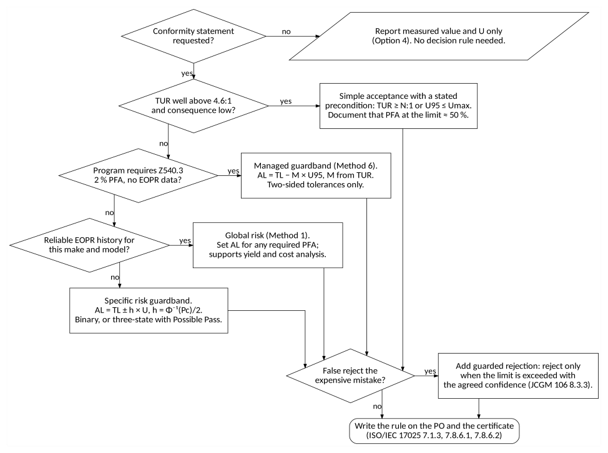
Figure 10. Decision rule selection, as the questions a lab actually asks. Adapted from the ILAC-G8 selection guide with the reliability-data question made explicit.
Question 0: Is a Conformity Statement Needed at All?
UKAS LAB 48 makes a point most labs forget. Conformity decisions are not a default requirement of ISO/IEC 17025. For most calibrations there is no prior requirement to report pass or fail. If the customer does not ask, report the measured values and uncertainties, state the specification as a fact if they want it, and let them decide at their convenience. No decision rule is needed, and none should be implied. This is Option 4 in the supplier language later in this part, and it is the correct default for a lab calibrating other labs' reference standards.
Question 1: Is the TUR High and the Consequence Low?
If yes, simple acceptance can be defended, provided it carries a precondition. ILAC-G8 defines simple acceptance as AL = TL, and the guidance indicates that without a constraint on uncertainty it may not satisfy Clause 3.7 at all. So write the constraint in: PASS when within tolerance AND TUR ≥ 4:1, or AND U95 ≤ 2 N. Document that specific PFA near the limit can approach 50 %, and have the customer agree to carry it. Use this when the TUR is well above 4.6:1, when the customer explicitly wants it and understands the risk, or when a wrong accept costs little.
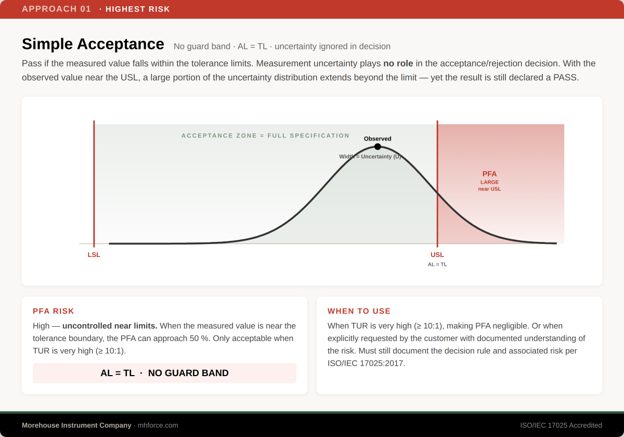
Figure 11. Simple acceptance: acceptance limit equals tolerance limit, and uncertainty plays no role in the decision itself.
Question 2: Do You Have Reliable History on This Instrument Population?
If not, use specific risk with a guardband. JCGM 106 defines specific risk in Bayesian terms, and JCGM GUM-5:2026 Example 10 confirms that when prior information is meagre, the single-distribution calculation comes out very close to the full Bayesian answer. That is most calibration work: one instrument, one result, no defensible population data. The rule reads: PASS when the specific PFA ≤ 2.5 % per side, otherwise FAIL. Part 6 gives the arithmetic. This method is conservative in the right direction, needs only the uncertainty and the result, and works for any risk level the customer names.
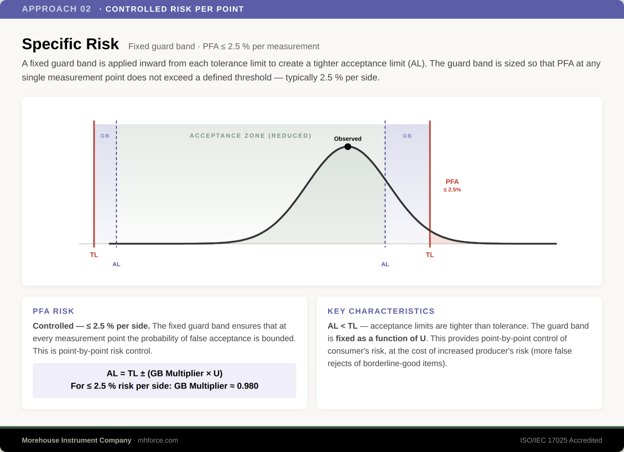
Figure 12. Specific risk: a fixed guardband sized so the PFA at any single measurement point does not exceed the agreed level.
If yes, you have real end-of-period reliability data for that make and model at that interval; global risk methods open up. Method 1 estimates unconditional PFA at the test-point level and lets you set acceptance limits for any required risk. It is the most flexible and the hardest to implement. It is also the route to the yield and cost analysis in Part 7.
Question 3: Does the Program Invoke the Withdrawn ANSI/NCSL Z540.3's 2 % Limit, with No Reliability Data?
Then use the managed guardband, Method 6, developed by Michael Dobbert. It needs no EOPR. It computes a multiplier M from the TUR, applies a guardband of M × U95, and holds the worst-case global PFA under 2 % across all combinations of TUR and out-of-tolerance rate. At TUR ≥ 4.6:1 the multiplier goes to zero and no guardband is required. Note that it is hard-coded to about 2 % and does not apply to one-sided tolerances.
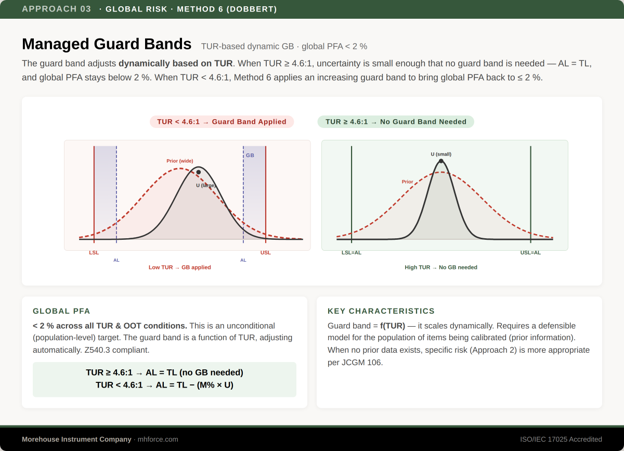
Figure 13. Managed guardband (Method 6): the guardband adjusts with TUR to hold global PFA below 2 % and vanishes at 4.6:1.
Question 4: Is a False Reject the Expensive Mistake?
Then consider guarded rejection. JCGM 106 Section 8.3.3.1 describes setting the rejection limit outside the tolerance so that a rejected item is almost certainly non-conforming. It is the speed-camera rule: the officer wants 99.9 % confidence you were speeding before writing the ticket. In the JCGM example, a 100 km/h limit measured with 2 % relative standard uncertainty becomes a rejection threshold of about 107 km/h. Use it when you need clear evidence a limit has been exceeded before taking a negative action.
Question 5: Binary, or Something in Between?
A binary rule forces every result into pass or fail. ILAC-G8 and LAB 48 both allow multi-state rules, and a three-outcome version is often the most honest: PASS when specific PFA is at or below the agreed level, FAIL when PFA is 50 % or more, and Possible Pass in between, with the result, the uncertainty, and the calculated PFA reported so the customer can decide disposition. Use this when a maximum PFA has not been specified, and the region near the limit is genuinely ambiguous.
Put It on the Purchase Order and the Certificate
The best rule is the one the end user writes down. Three examples from the Decision Rule Guidance, each a complete instruction:
Simple acceptance with a precondition: Issue a PASS when the measured value is within ±10 N of the applied force and U95 ≤ 2 N; otherwise FAIL. (Notice the 5:1 TUR requirement?)
Specific risk, binary: Issue a PASS when the PFA using specific risk is ≤ 2 %; otherwise FAIL.
Specific risk, multi-state: Issue a PASS when the PFA using specific risk is ≤ 2 %, a FAIL when PFA > 50 %, otherwise a Possible Pass.
A supplier can offer the same choices as a menu. Option 1, simple acceptance with a TUR or capability precondition. Option 2, a conservative guardband of one full expanded uncertainty, the older ILAC-G8 rule. Option 3, Method 6 with PFA under 2 %. Option 4, measured result and uncertainty only. State the default. No option is inherently superior; the suitability depends on the customer's needs, the contract, and the risk they are willing to carry.
The Boundary
The decision rule is the agreement. It is not the TUR (that is a precondition inside some rules), not the guardband (that is the tool the rule uses), and not the PFA (that is what the rule controls). Pick it before the measurement is made, write it where the customer and the assessor can both find it, and apply it the same way every time.
-Henry Zumbrun, Morehouse Instrument Company
References
Sources cited across Parts 1 through 7, listed alphabetically. JCGM documents follow the citation form the BIPM recommends, with the member-organization author line and the JCGM DOI. Clause numbers given in the text refer to these editions.
A2LA. R205 — Specific Requirements: Calibration Laboratory Accreditation Program. American Association for Laboratory Accreditation, Frederick, MD.
ANSI/NCSL Z540.3-2006 (R2013). Requirements for the Calibration of Measuring and Test Equipment. NCSL International, Boulder, CO, 2006.
ASME B89.7.4.1-2005. Measurement Uncertainty Conformance Testing: Risk Analysis. The American Society of Mechanical Engineers, New York, 2005.
ASTM E74-18. Standard Practices for Calibration and Verification for Force-Measuring Instruments. ASTM International, West Conshohocken, PA, 2018. https://doi.org/10.1520/E0074-18
BIPM. The BIPM key comparison database (KCDB). Bureau International des Poids et Mesures, Sèvres. https://www.bipm.org/kcdb/
BIPM, IEC, IFCC, ILAC, ISO, IUPAC, IUPAP and OIML. Evaluation of measurement data — Guide to the expression of uncertainty in measurement. Joint Committee for Guides in Metrology, JCGM 100:2008. https://doi.org/10.59161/JCGM100-2008E
BIPM, IEC, IFCC, ILAC, ISO, IUPAC, IUPAP and OIML. Evaluation of measurement data — The role of measurement uncertainty in conformity assessment. Joint Committee for Guides in Metrology, JCGM 106:2012. https://doi.org/10.59161/JCGM106-2012
BIPM, IEC, IFCC, ILAC, ISO, IUPAC, IUPAP and OIML. International vocabulary of metrology — Basic and general concepts and associated terms (VIM), 3rd edition. Joint Committee for Guides in Metrology, JCGM 200:2012. https://doi.org/10.59161/JCGM200-2012
BIPM, IEC, IFCC, ILAC, ISO, IUPAC, IUPAP and OIML. Guide to the expression of uncertainty in measurement — Part 5: Examples. Joint Committee for Guides in Metrology, JCGM GUM-5:2026. https://doi.org/10.59161/JCGMGUM-5-2026
Carroll, L. Alice's Adventures in Wonderland. Macmillan, London, 1865.
Cenker, G., Zumbrun, H. and Shah, D. Decision Rule Guidance. Morehouse Instrument Company, York, PA. https://mhforce.com/documentation-tools/
Dobbert, M. "A Guard-Band Strategy for Managing False-Accept Risk." Proceedings of the NCSL International Workshop & Symposium, Orlando, FL, 2008.
Eagle, A. R. "A Method for Handling Errors in Testing and Measuring." Industrial Quality Control, Vol. 10, pp. 10–15, March 1954.
Grubbs, F. E. and Coon, H. J. "On Setting Test Limits Relative to Specification Limits." Industrial Quality Control, Vol. 10, pp. 15–20, March 1954.
Harris, G. L. "GMP 13 — Good Measurement Practice for Ensuring Traceability." In: Selected Laboratory and Measurement Practices and Procedures to Support Basic Mass Calibrations, NIST IR 6969, National Institute of Standards and Technology, Gaithersburg, MD, 2019.
Hayes, J. L. Factors Affecting Measuring Reliability. U.S. Naval Ordnance Laboratory, Technical Memorandum No. 63-106, Corona, CA, 1955.
ILAC-G8:09/2019. Guidelines on Decision Rules and Statements of Conformity. International Laboratory Accreditation Cooperation, 2019.
ILAC-P14:09/2020. ILAC Policy for Measurement Uncertainty in Calibration. International Laboratory Accreditation Cooperation, 2020.
ISO/IEC 17025:2017. General requirements for the competence of testing and calibration laboratories. International Organization for Standardization, Geneva, 2017.
ISO/IEC 17043:2023. Conformity assessment — General requirements for the competence of proficiency testing providers. International Organization for Standardization, Geneva, 2023.
Mimbs, S. M. "Using Reliability to Meet Z540.3’s 2 % Rule." NCSL International Workshop & Symposium, National Harbor, MD, 2011. NASA KSC-2011-151.
Morehouse Instrument Company. Decision Rules Interactive Calculator. https://decisionrules.mhforce.com
Morehouse Instrument Company. Guidance on Uncertainty Budgets for Force Measuring Devices. York, PA. https://mhforce.com/documentation-tools/
Morehouse Instrument Company. GUM in Plain English (series). York, PA. https://mhforce.com/documentation-tools/
Morehouse Instrument Company. Morehouse CMC Workbook. York, PA. https://mhforce.com/documentation-tools/
Morehouse Instrument Company. Morehouse True Cost Calculator and The True Cost of Measurement Decisions. York, PA. https://mhforce.com/documentation-tools/
Morehouse Instrument Company. Start With the End in Mind. York, PA, 2026. https://mhforce.com/wp-content/uploads/2026/05/Start_With_The_End_in_Mind.pdf
Morehouse Instrument Company. Probability of False Reject (PFR) (webinar). York, PA.
NASA-HDBK-8739.19-4. Estimation and Evaluation of Measurement Decision Risk. NASA Measurement Quality Assurance Handbook, Annex 4. National Aeronautics and Space Administration, Washington, DC, 2010.
NCSL International. Handbook for the Application of ANSI/NCSL Z540.3-2006 — Requirements for the Calibration of Measuring and Test Equipment. NCSL International, Boulder, CO, 2009.
Peart, N. "Freewill." Performed by Rush on Permanent Waves. Anthem Records, 1980.
Reese, P. and Harben, J. "Risk Mitigation Strategies for Compliance Testing." NCSLI Measure, Vol. 7, No. 1, 2012.
UKAS. LAB 48: Decision Rules and Statements of Conformity, Edition 5. United Kingdom Accreditation Service, Staines-upon-Thames, 2024.
About Morehouse
We believe in changing how people think about Force and Torque calibration in everything we do, including, "Where One Term Ends and the Next Begins, Part 5 of 7: Decision Rule Selection - Which Rule to Use and When"
This includes setting expectations and challenging the "just calibrate it" mentality by educating our customers on what matters and what may cause significant errors.
We focus on reducing these errors and making our products simple and user-friendly.
This means your instruments will pass calibration more often and produce more precise measurements, giving you the confidence to focus on your business.
Companies around the globe rely on Morehouse for accuracy and speed.
Our measurement uncertainties are 10-50 times lower than the competition, providing you with more accuracy and precision in force measurement.
We turn around your equipment in 7-10 business days so you can return to work quickly and save money.
When you choose Morehouse, you're not just paying for a calibration service or a load cell.
You're investing in peace of mind, knowing your equipment is calibrated accurately and on time.
Through Great People, Great Leaders, and Great Equipment, we empower organizations to make Better Measurements that enhance quality, reduce risk, and drive innovation.
With over a century of experience, we're committed to raising industry standards, fostering collaboration, helping with understanding risk, and delivering exceptional calibration solutions that build a safer, more accurate future.
Contact Morehouse at info@mhforce.com to learn more about our calibration services and load cell products.
Email us if you ever want to chat or have questions about a blog.
We love talking about this stuff. We have many more topics other than, "Where One Term Ends and the Next Begins, Part 5 of 7: Decision Rule Selection - Which Rule to Use and When"
Our YouTube channel has videos on various force and torque calibration topics here.